

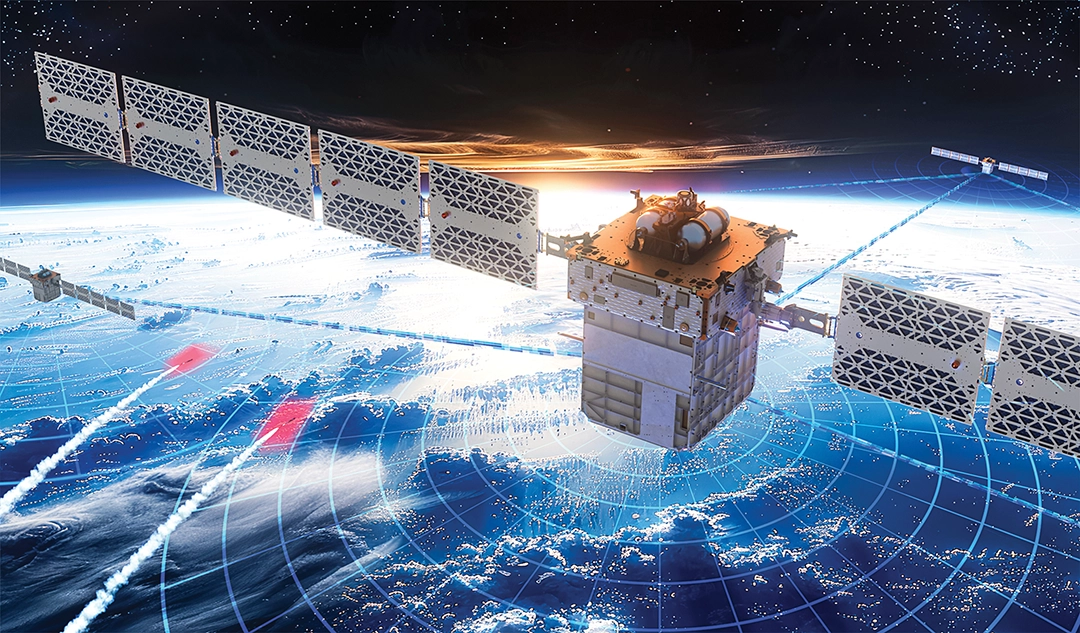
For decades, United States military space strategy relied on a handful of expensive satellites orbiting high above Earth — exquisite technological marvels that served as the central nervous system of modern warfare. But those systems carried a dangerous flaw: They were giant bull’s-eyes.
Today, Department of War (DOW) planners worry that in a conflict with Russia or the Chinese Communist Party (CCP), many of these satellites could be jammed, hacked, blinded, or destroyed within hours. The result could cripple communications, missile warning systems, intelligence gathering, navigation, and battlefield coordination.
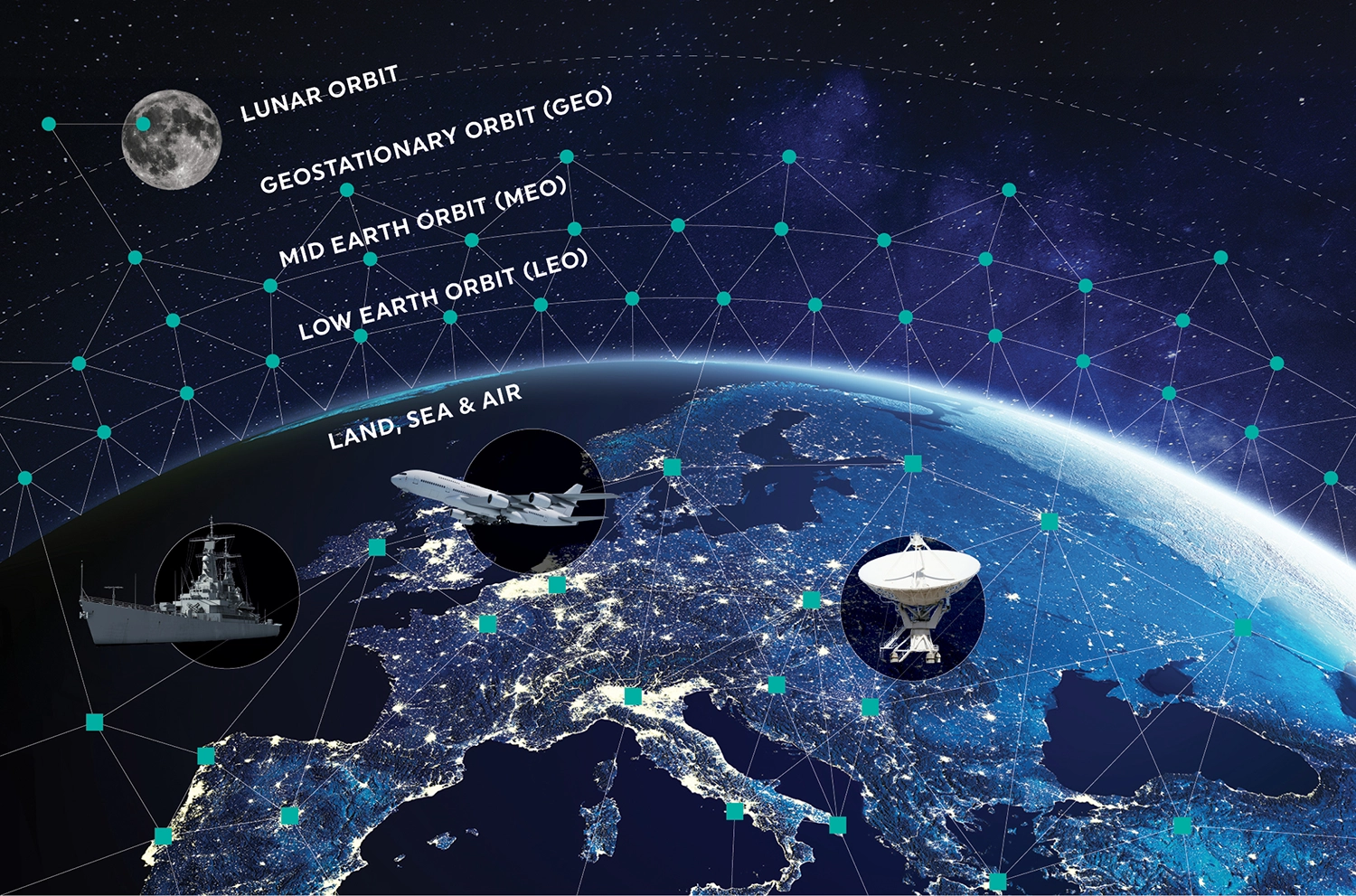
The prospect of losing critical capabilities has prompted the Pentagon to rethink some of its basic assumptions about how military space systems should be built and operated. Now, the U.S. military is attempting something different, building what many officials describe as an Internet of Space Things — a sprawling network that combines military spacecraft with commercial satellites, cloud-computing systems, artificial intelligence (AI) tools, and resilient communications pathways.
The initiative, also known as Hybrid Space Architecture, or HSA, represents a departure from the Cold War era model of national security space. Instead of depending on a small number of high-value assets, the Pentagon is pursuing a distributed web of interoperable systems spanning multiple orbits, developed by the Defense Innovation Unit (DIU), the U.S. Space Force’s Space Systems Command and private industry. The idea is simple but transformative: If one satellite is disabled, hundreds or even thousands of others can help keep information flowing.
“The U.S. military requires accelerated integration of commercial space technologies to stay ahead of rapidly evolving threats,” the DIU said in a May 2025 announcement expanding the program.
Todd Harrison, a defense policy analyst and senior fellow at the Washington, D.C., think tank the American Enterprise Institute, said the shift reflects a growing recognition that future space systems must be designed to withstand attack rather than simply avoid it. “We need to try to build more disaggregated, dispersed constellations, where we’ll be more resilient to attack, and we can reconstitute faster,” Harrison told Apogee.
The architecture draws together technologies from companies including SpaceX, Amazon, Microsoft, Google, Viasat, Lockheed Martin and Palantir Technologies, along with dozens of specialized firms focused on communications, cybersecurity and data analytics.
SpaceX has emerged as one of the most important contributors to the Pentagon’s evolving vision. In May, the Space Force awarded the company contracts worth more than $6 billion to support two essential functions of the future architecture — collecting information and moving it across the network.
One award supports development of the Space Data Network Backbone, an optical communications mesh intended to connect military sensors, satellites and commanders around the globe. The second funds the Space-Based Airborne Moving Target Indicator program, a constellation designed to track aircraft, cruise missiles and other airborne threats from orbit.
Together, the contracts place SpaceX at the center of two critical military missions — sensing and communications. They also illustrate the Pentagon’s growing willingness to rely on commercial providers for capabilities once reserved almost exclusively for government systems.
As defense analyst Kimberly Burke told The Wall Street Journal, SpaceX’s ambitions extend well beyond launch services. “They want to be the rails that all of the trains are riding on,” Burke said. “SpaceX very much wants to be the backbone” of government operations in low Earth orbit (LEO).
The HSA initiative was launched in 2022 through a partnership among the DIU, the Space Force and the Air Force Research Laboratory. What began as an experiment has evolved into one of the Pentagon’s most closely watched space modernization programs.
In 2025, the DIU announced a major expansion, adding more than a dozen companies to the effort and outlining demonstrations across the Indo-Pacific, Europe, Central Asia and South America. The goal is to field an operational pilot network sometime in 2026. “This is a winning collaboration between DIU, SSC and the commercial space industry to advance Hybrid Space Architecture for the U.S. Space Force,” Col. Timothy Trimailo, director of the Space Systems Command (SSC) Commercial Space Office, said in announcing the expansion.
The stakes extend far beyond space acquisition. Modern warfare increasingly depends on uninterrupted flows of information. From directing drones and guiding missiles to coordinating naval fleets and tracking troop movements, military advantage now depends as much on the movement of data as on the movement of forces.
That challenge lies at the center of the Pentagon’s effort to connect military operations across land, sea, air, cyber, and space into a unified combat network. HSA is designed to serve as part of that foundation. In theory, the architecture would allow intelligence gathered by a commercial radar satellite to be processed by AI, routed through multiple communications pathways, fused with information from military systems, and delivered to commanders within seconds.
Supporters argue that such networks would fundamentally change the economics of space warfare. Unlike legacy architectures built around a few billion-dollar satellites, proliferated constellations are designed to absorb losses without collapsing. Destroying individual satellites becomes less effective when hundreds of alternatives remain available. “It flips the cost-exchange ratio for an adversary,” Harrison said, noting that anti-satellite weapons may ultimately cost more than many of the smaller satellites they target.

A 2022 report by the National Academies of Sciences, Engineering, and Medicine reached a similar conclusion, describing hybrid architecture as “resilient by design.” The report, “Leveraging Commercial Space for Earth and Ocean Remote Sensing,” said that diversity and large numbers of interconnected systems distribute risk and allow networks to degrade gradually rather than fail catastrophically.
The urgency behind the effort stems from growing concern that Russia and the CCP are developing sophisticated anti-satellite weapons, cyberattack capabilities, and electronic warfare systems intended to target U.S. space infrastructure.
That concern is shared among U.S. allies, who describe space as a contested warfighting domain. Writing in a NATO Science and Technology Organization study, Giovanni Sembenini of Italy’s Ministry of Defence warned that adversaries are actively developing capabilities designed to disrupt allied space systems.
Addressing defense researchers in March 2026, Sembenini described hybrid architectures as a paradigm shift that can transform military operations through greater resilience, interoperability and adaptability.
Part of that resilience comes from diversity. Rather than relying exclusively on traditional geostationary satellites, hybrid architectures combine spacecraft operating in low, medium, and geostationary orbit, creating multiple pathways for communications and data transport.
The Pentagon also sees value in what it calls multipath communications. If weather disrupts one transmission route or an adversary jams a particular frequency, software can automatically reroute information through alternate pathways.
“It’s not going to make sense for China or Russia to try to shoot down every Starlink satellite,” Harrison said. “They’re not going to achieve their goal that way.”
The vision, however, comes with challenges. Integrating military, commercial, allied, and civilian systems into a single operational architecture is complex. Different companies use different software, communications standards, security protocols, and business models. Creating a network that can seamlessly connect disparate systems while maintaining military-grade security poses a formidable challenge.
Trust may prove to be an equally difficult hurdle. Even highly distributed constellations remain vulnerable to cyberattacks and electronic warfare. Harrison noted that commercial systems often face greater exposure because they must connect to public networks in ways many traditional military systems do not. Defense planners must determine how to incorporate commercial data streams without exposing sensitive operations or creating vulnerabilities that adversaries could exploit.
The National Academies warned that hybrid architectures will require what it called a variable trust framework that can evaluate and integrate information from diverse sources with different levels of reliability and security.
The challenge extends beyond technology. The report identified a range of organizational and operational hurdles, including interoperability standards, secure cloud infrastructure, adaptive communications protocols, onboard processing capabilities, and rapid launch systems that can replenish constellations during wartime.
Cultural barriers may be just as significant. For decades, the DOW relied primarily on traditional defense contractors operating through lengthy acquisition cycles and highly customized programs. Hybrid architecture requires a different mindset — one built around continuous collaboration with commercial firms accustomed to moving at the pace of Silicon Valley rather than Washington.
“Trust in new partners, the ability to experiment with new approaches, the willingness to be flexible, and a greater acceptance of risk will be required,” the National Academies report concluded.
Some military leaders argue that transformation is already underway. The Space Force has spent the past several years examining programs across its portfolio to determine where commercial capabilities can replace or augment government-developed systems. Officials say the effort reflects a broader recognition that commercial innovation is often advancing more rapidly than traditional defense acquisition.
Lt. Gen. Philip A. Garrant, commander of Space Systems Command, described the review process during the 2025 Space Symposium in Colorado Springs, Colorado. “Nobody got a pass,” Garrant said. “Everybody has to do this excursion of: ‘Could I start over and meet my requirements commercially?’”
The shift reflects a broader reality facing defense planners. Commercial companies now launch satellites in months rather than years. Global broadband constellations already operate at enormous scale. Software updates occur continuously, while advances in AI and cloud computing originate outside government laboratories.
As a result, the Pentagon is moving toward a model in which it acts less as the sole builder of space infrastructure and more as an anchor customer, purchasing services and integrating commercial innovations while concentrating government resources on uniquely military missions.
The roster of companies participating in HSA illustrates that evolution. Established aerospace firms are working alongside startups focused on synthetic-aperture radar, laser communications, edge computing, zero-trust cybersecurity, and AI-enabled analytics.
Among the key participants is Aalyria Technologies, whose networking software is designed to coordinate communications among diverse satellite constellations. SpiderOak contributes cybersecurity capabilities, while Anduril Industries focuses on autonomous systems and command and control integration.
The initiative is also intertwined with the Proliferated Warfighter Space Architecture, the Space Force’s growing constellation of military satellites designed to provide missile tracking and low-latency communications.
Together, these efforts point to a future in which military and commercial space systems become deeply interconnected. That prospect raises difficult strategic questions. If commercial satellites become part of military targeting and communications networks, do they become legitimate wartime targets? What responsibilities do private companies assume when their systems support military operations? And how should allies coordinate access to shared commercial networks during a conflict?
Those questions are no longer theoretical. In 2025, NATO adopted its first Commercial Space Strategy, reflecting the alliance’s growing recognition that private-sector capabilities will play an increasingly important role in future operations. The strategy calls for closer cooperation with commercial providers, more flexible acquisition models and expanded use of commercial services during both peacetime and conflict.
For NATO officials, interoperability has become a strategic necessity rather than merely a technical objective. “We all win together or we go down together if interoperability is not designed into the systems from the beginning,” Sembenini warned.
Supporters of hybrid architecture argue that such interoperability is essential to future deterrence. Their goal is not simply to build a better satellite network but also to create a system so vast, distributed and adaptable that adversaries cannot disable it.
The military implications could be significant. In a crisis involving Taiwan, a hybrid architecture could help U.S. and allied forces maintain communications, missile warning and targeting capabilities even under sustained attack. In Europe, commercial sensing networks could provide persistent surveillance of military activity. During natural disasters, many of the same capabilities could support civilian communications and emergency response efforts.
Yet technology alone may not determine whether the concept succeeds. A March 2026 report by the Potomac Institute for Policy Studies in Arlington, Virginia, concluded that dozens of existing laws, regulations, and bureaucratic practices could slow the Space Force’s transition to a fully integrated hybrid architecture. Researchers identified obstacles ranging from classification restrictions and export controls to acquisition requirements and interoperability standards developed long before today’s commercial space economy emerged.
Many of those barriers are manageable, the study concluded. But delays in addressing them could leave the United States at a disadvantage against competitors who are moving more aggressively to integrate commercial capabilities.
The report also argued that space superiority may depend less on hardware than on data. Rather than treating military, commercial and allied information streams separately, researchers urged the Space Force to adopt advanced AI tools and modern zero-trust architectures that can fuse information from multiple sources in real time. Combining those streams, the study argued, could provide commanders with a more complete operational picture while improving resilience in contested environments. The Space Force “must prepare the hybrid architecture for war,” the Potomac Institute report said.
For now, the concept remains partly experimental. Demonstrations scheduled across combatant commands in the coming year will test whether dozens of commercial technologies can operate together as a coherent military network. The DIU plans to activate live hybrid networks supporting exercises, demonstrations and warfighting experiments as it works toward a potential operational pilot.
Pentagon officials believe future conflicts may be decided not by a handful of exquisite satellites but by the ability to connect thousands of systems into a resilient web capable of surviving attack. If they are right, HSA could reshape how wars are fought in space while also providing an off-ramp toward deterrence.
The stakes extend well beyond technology. At issue is whether the United States and its allies can build a space infrastructure resilient enough to preserve military advantage in an era when orbit is becoming crowded, contested, and strategically important.
As Trimailo pointed out during the July 2025 Innovate Space: Global Economic Summit in Arlington, integrating commercial capabilities into future defense architectures is strategically necessary.
“It’s no longer just augmentation,” he said. “It’s an imperative. The amount of investment we’re seeing across the global space private industry, from our allied partners, is pretty staggering.”