


For decades, U.S. space strategy rested on a foundational assumption: that satellites, once launched into precise orbits, could remain there, static, predictable, and largely unthreatened. That assumption no longer holds.
What Apollo Maneuvers 2026 and the subsequent confirmation of U.S. on-orbit weapons represent is not simply a pair of headline-grabbing announcements. They are the clearest operational signal yet that U.S. Space Command is moving from planning a new doctrine to executing one.
As adversary counterspace capabilities have advanced, from China’s demonstrated direct-ascent anti-satellite capability to Russia’s electronic warfare systems and maneuvering spacecraft, the logic of keeping U.S. space assets in predictable, targetable orbits has grown increasingly untenable.
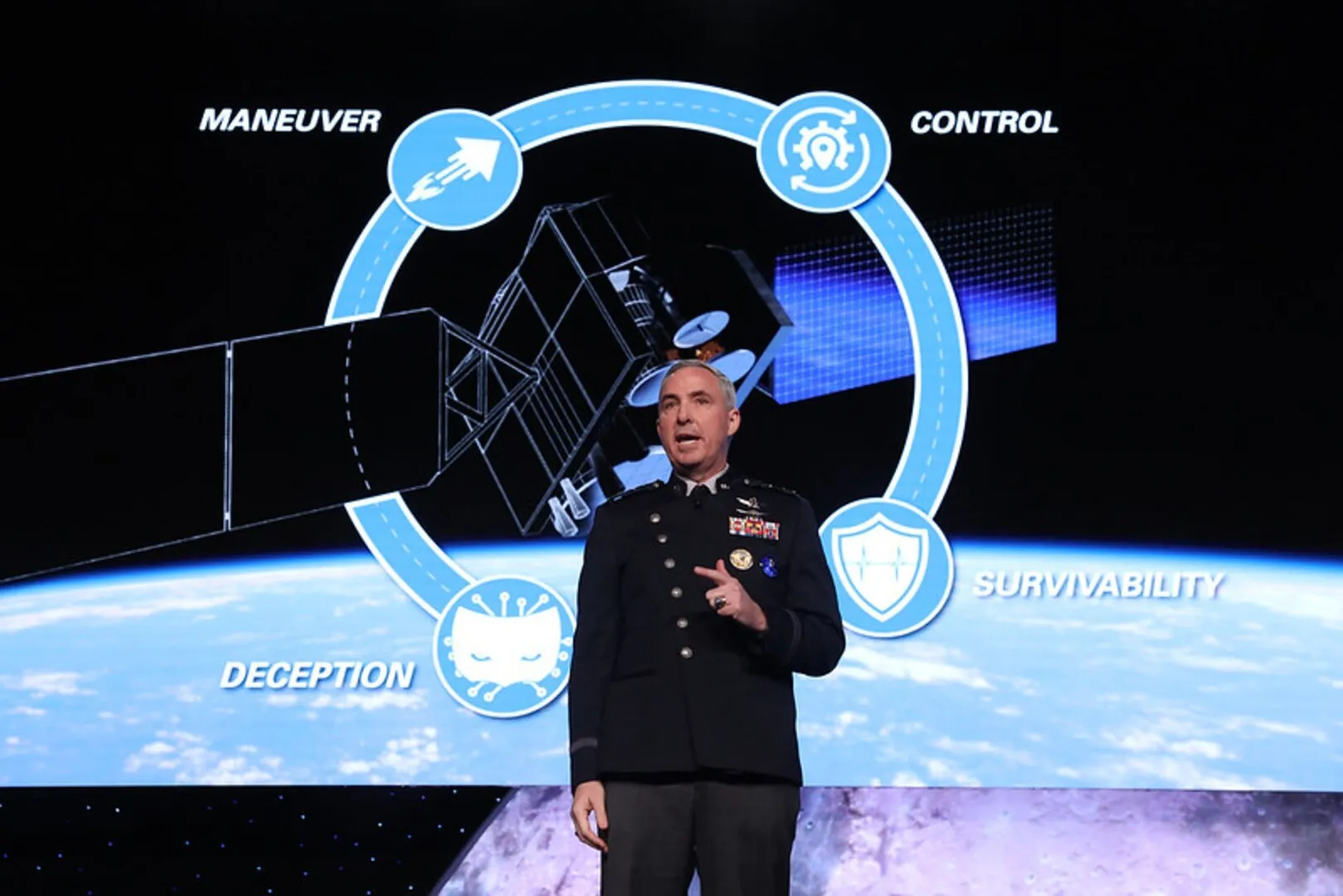
Gen. Stephen Whiting, commander of U.S. Space Command and the Multinational Force-Operation Olympic Defender, has been explicit about the strategic response. “We need a different strategy to deter and win a global, protracted conflict against a great power,” he said in April 2025 at the Space Foundation’s Space Symposium. “That strategy is maneuver warfare.”
Apollo Maneuvers 2026 was the first live test of whether that strategy can actually be executed.
Putting the doctrine to work
The exercise focused on three interconnected tasks: conducting coordinated maneuvers simultaneously across low Earth orbit (LEO), medium Earth orbit (MEO), and geosynchronous orbit (GEO); refining the maneuver warfare concepts Whiting has championed; and integrating the allied nations of Multinational Force-Operation Olympic Defender (Australia, Canada, France, Germany, New Zealand, the United Kingdom, and the United States) into the exercise.
That last element deserves more attention than it typically receives. Space maneuver warfare is not a capability that works in isolation. Its deterrent value depends on an adversary understanding that contesting U.S. space assets means simultaneously contesting the assets of seven allied nations, each contributing sensing, tracking, and operational planning frameworks to a shared picture. Collective defense is not a diplomatic courtesy; it is a force multiplier that makes the cost of aggression calculably higher for any potential adversary.
“The integration of allied, partner and commercial capabilities strengthens joint and combined operations and enabled the validation of combined tactics, techniques and procedures,” U.S. Space Command said in its September 8 statement.
The operational concept being tested, which analysts have described as “orbital dogfighting,” borrows the language of close-range aerial combat and involves maneuvering satellites and other spacecraft in proximity to one another within a simulated conflict environment. The term also captures a broader conceptual shift: space operations are being reconceived not as the management of fixed infrastructure but as the active contest of orbital positions.
That is a significant departure from how the United States has operated in space for most of its history.
Executing it requires not just different hardware but a fundamental change in institutional mindset, in planning processes, in how directorates coordinate, in how allies are integrated from the ground up.
Apollo Maneuvers 2026 was designed to stress-test all of it at once.
The weapons behind the doctrine
What gives the doctrine its operational teeth became clearer within days of the exercise concluding. U.S. Secretary of the Air Force Troy Meink, speaking at the 2026 Air and Space Cyber Conference on September 14 in Maryland, confirmed what Whiting had publicly called for at the previous year’s Space Symposium: the United States has weapons in orbit.
“We are increasing readiness against existing threats, and the United States has on-orbit space control weapons capable of defending the Joint Force against hostile adversary action,” Meink said.
For years, Washington had not publicly acknowledged that it had deployed weapons in orbit, maintaining ambiguity around its space-control capabilities. The disclosure came immediately after the first live-fly maneuver warfare exercise, linking two developments that point toward a more overt U.S. approach to space warfare.
It tells adversaries that the United States is not only capable of maneuvering in a contested orbital environment but has the means to defend that environment, kinetically if necessary, in support of the Joint Force and allied partners who depend on space for their security.

“Space control encapsulates the mission areas required to contest and control the space domain, employing kinetic and non-kinetic means to affect adversary capabilities through disruption, degradation, and even destruction, if necessary,” a U.S. Space Force statement said. “These capabilities can be employed for offensive and defensive purposes.”
Preserving ambiguity about the precise nature and location of on-orbit weapons is itself a strategic choice, one that sustains uncertainty in adversary planning while reinforcing the credibility of U.S. deterrence across the full spectrum of space operations.
A domain no longer unchallenged
The reactions from Beijing and Moscow, both of which issued statements opposing the disclosure, underscore a reality the U.S. Space Force has been documenting publicly for years.
The U.S. Space Force says China “develops and operates space and counterspace capabilities as part of a military modernization strategy,” while Russia “views space as a warfighting domain and believes space supremacy will be a decisive factor in future conflicts.”
India joined the group of nations with demonstrated counterspace capabilities in 2019, when it destroyed a low-Earth-orbit satellite in a missile test.
That is the environment Apollo Maneuvers 2026 was built to address.
What the exercise demonstrated, and what the Meink disclosure reinforced, is that the United States has made a deliberate choice: to treat space as a warfighting domain where assets maneuver, compete, and, if necessary, fight, and to do so alongside allies who are integrated into that doctrine from its foundations.
The U.S. and its partners are not simply reacting to adversary behavior. They are establishing, through demonstrated capability and coalition commitment, the conditions under which responsible use of the space domain can be preserved for partners and allies who share that vision.