

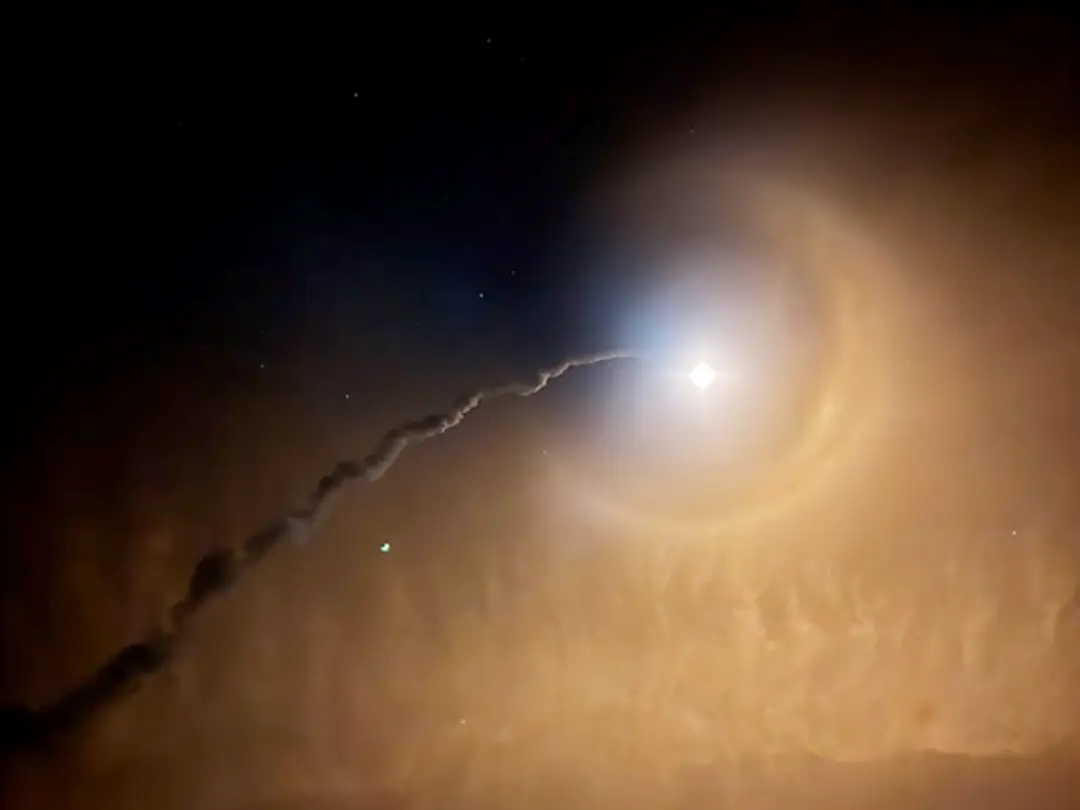
The United States and Japan have taken another step toward closer cooperation in space defense, launching a U.S. Space Force sensor aboard a Japanese navigation satellite and rocket in a mission officials say will strengthen surveillance of an increasingly contested Indo-Pacific region.
The Quasi-Zenith Satellite-7, or QZS-7, lifted off August 10 aboard Japan’s H-3 launch vehicle from the Tanegashima Space Center in southern Japan. The satellite carries a U.S. space domain awareness (SDA) payload designed to provide near-real-time information about objects operating in geosynchronous orbit above the Indo-Pacific.
The launch completed the two-satellite Quasi-Zenith Satellite System-Hosted Payload, or QZSS-HP, program. The initiative is the first bilateral U.S.-Japan cooperative space effort focused on national security, according to U.S. Space Systems Command.
The payload will be operated by Mission Delta 2, the Space Force organization responsible for SDA. Data from the sensor will feed the U.S. Space Surveillance Network (SSN), giving American operators another source of information for identifying and tracking objects in space.
“The successful launch of QZS-7 is a powerful testament to the enduring strength and rapid modernization of the U.S.-Japan alliance,” Col. Bryon E.C. McClain, Space Force portfolio acquisition executive for Space Combat Power, said in an Aug. 14 Space Systems Command (SSC) news release.
“By continuing to merge our capabilities in space modernization and satellite communications, we are maintaining security in a contested space domain and fortifying our shared deterrence capabilities across the Indo-Pacific region,” McClain said.

The mission reflects a broader effort by Washington and Tokyo to integrate their space capabilities. Japan’s Quasi-Zenith Satellite System is designed to augment the U.S. Global Positioning System across Japan and the surrounding region. The QZSS satellites operate in geosynchronous orbits, making them useful platforms for observing activity in an orbital region important to military operations.
The QZS-7 payload is the second U.S. sensor deployed through the program. The first was launched aboard QZS-6 in February 2025, also on a Japanese H-3 rocket. Both payloads were designed and built by the Massachusetts Institute of Technology’s Lincoln Laboratory, while the Japanese host satellites were designed and built by Mitsubishi Electric Corp.
The sensors are intended to strengthen the SSN, a collection of ground- and space-based radars and telescopes used to track objects in orbit. The network is operated by the 18th Space Defense Squadron at Vandenberg Space Force Base, California.
The additional surveillance comes as the number of satellites and other objects in orbit continues to grow and as U.S. officials emphasize the need to understand the behavior of potentially hostile spacecraft.
“The QZSS-HP is a key contributor to help us meet the threat of peer adversaries in space and build towards resilient capabilities to detect, understand, and maintain custody of objects in deep space,” Col. Gina Peterson, deputy commander of Mission Delta 2, said in the Aug. 14 SSC news release.
The program also illustrates how the U.S. is seeking to use allied infrastructure and capabilities to expand its presence in space. Rather than requiring every U.S. sensor to fly on an American spacecraft and launch vehicle, the arrangement allows Washington to take advantage of a Japanese satellite and Japan’s growing launch capability.
The cooperation has been years in the making. The Space Force and Japan’s Office of National Space Policy signed a memorandum of understanding in December 2020 to jointly execute the program. At the time, American officials described space domain awareness as an essential element of protecting both nations’ space operations.
“Enhancing space domain awareness is essential to protect the space operations of the U.S, Japan, and other partners,” the U.S. Space Force said in announcing the agreement. “A secure, stable, and accessible space domain is critical to our national security, the health of our respective economies, and enables scientific endeavors which provide environmental benefits.”
The partnership has expanded as concerns about activity in space have grown. China’s presence in space has grown in recent years, surpassing 1,000 satellites in 2024 and with some of them conducting complex maneuvers in geosynchronous orbit.
For Japan, the cooperation adds a national security function to a satellite system primarily intended to provide positioning, navigation and timing services. For the United States, it provides another sensor positioned over a strategically important region while deepening interoperability with a major Pacific ally.
The two countries’ work extends beyond space domain awareness. U.S. and Japanese officials have emphasized cooperation in satellite communications, data sharing, space modernization and other capabilities as they seek to make their forces more resilient.
“The U.S.-Japan Alliance is one of our greatest strategic advantages in the Pacific,” Brig. Gen. Brian A. Denaro, commander of U.S. Space Forces Pacific, said in the SSC release.
The QZSS-HP program, Denaro said, demonstrates how the two countries can strengthen their capabilities through cooperation that stretches from satellite design to launch and operations.
“Partnerships like this don’t simply produce new capabilities, they build the trust, integration, and readiness that strengthen deterrence, reinforce our collective security, and preserve freedom of action in, from, and to space,” he said.