


U.S. space defense leaders follow a precise set of priorities in pursuing their goal of space superiority: develop next-generation missile defense technologies, counter threats from all orbits, create a responsive and adaptive space architecture, and strengthen ally and partner contributions to collective space security.
Achieving these benchmarks, spelled out in a December 2025 White House executive order, is a big ask for the Department of War (DOW). But when it comes to finding the right path toward success, one U.S. Space Force officer charged with helping get there just reaches for the “easy button.”
The easy button, popularized in an ad campaign by an office supply store, is how Col. Timothy Trimailo describes a foundational Space Force strategy known as “allied by design.” The concept has expanded from partnerships with militaries in allied nations to include partners in commercial space — both domestic and international.
“I firmly believe that the way for us as a service to be truly allied by design, the easy button for that, is through commercial capabilities,” said Trimailo, director of the Space Force Commercial Space Office (COMSO). The office is responsible for accelerating commercial partnerships to deliver capabilities that meet warfighter needs.
With speed and innovation fueled by the marketplace and largely unburdened by bureaucracy, commercial space is recognized as so valuable to national security that expanding its involvement has become a matter of national policy for the U.S. and many of its allies. Commercial operators dominate the field of national security launch and provide a growing amount of data relied upon by military space watchers. This sharing of a space asset between commercial and military interests has come to be known as dual use.
Commercial space also can get around many of the security classification requirements that slow progress in the domain, Trimailo told Apogee. “When we try to share commercial capabilities, because they are typically unclassified, because they are available on the open market, it’s a lot easier to be able to share our U.S. commercial company capabilities with our allied partners.”
The military’s reliance on commercial space only will grow, according to “Integrating Commercial Space Services into the [Department of War] Architecture,” an April 2025 report from the Rand Corp. think tank. “Commercial space services offer [DOW] an opportunity to meet its evolving mission needs by improving capacity, capability, and responsiveness and enhancing the overall resiliency of space missions,” the report said. “The department is moving forward in providing strategic guidance on how to take advantage of these important capabilities.”
During discussions at the April 2026 Space Symposium in Colorado Springs, Colorado, Space Force leaders emphasized the speed to deployment that commercial integration brings to space defense.
Asked what advice he has for companies seeking to break into the market, Maj. Gen. Anthony Mastalir, director of global space operations with U.S. Space Command (USSPACECOM), said, “What I would tell industry today is, No. 1, stay in contact — understand what the threat is, and then be prepared to scale.”
Brig. Gen. Maurice Barnett, USSPACECOM director of strategy, plans and policy, lauded the space industry’s innovative spirit: “I once heard someone say that humans are the only living beings that have imagination … and if we’re going to be successful, we’re going to have to do some really creative things.”
International challenges
Securing products and services for U.S. space defense from companies outside the country carries a number of hurdles, making the easy button a little harder to push. These can include compliance with the International Traffic in Arms Regulations, requirements under the Foreign Military Sales program, and the need to obtain exceptions to the Buy America Act. Many international companies opt to partner with a U.S. prime contractor or establish their own U.S. subsidiaries.
“On the international commercial front, it becomes a little bit more challenging,” Trimailo said. “But there are still several examples where we’ve taken advantage of international commercial company capability. It’s just more nuanced. Every single example, probably, takes a little bit of a different process.”
The exchange is improving, he said, as practice follows policy. “I’ve tried to share software tools that we’ve built with our international partners in the past, and we end up, in a couple of examples, at a roadblock, never able to deliver. We meet with international partners all the time now who want to take advantage of U.S. capabilities. And frankly, that’s good for the U.S. government, too, because by doing foreign military sales, we’re generating revenue for our government with all its great work. And that generates even more innovation here in the homeland, for us to be more capable.”
COMSO, part of the Space Force’s Los Angeles-based Space Systems Command (SSC), works closely with another of the command’s components — the International Affairs office, or SSC/IA. An SSC/IA fact sheet lists eight capabilities the service is working on with international partners, including satellite communications, space domain awareness, and position, navigation, and timing.
One international company that established a U.S. subsidiary is the France-based global satellite giant Eutelsat, founded in 1977 to provide Europe with satellite communications. The company is bidding to host U.S. military and intelligence payloads on the internet broadband constellation operated in low Earth orbit (LEO) by its OneWeb subsidiary, which competes with constellations including the now-dominant Starlink network from U.S.-based SpaceX.
To speed deployment and cut costs, the Space Force takes an approach of “lease, buy, build” to obtain the capabilities it seeks — lease commercially, buy off the shelf, build only if necessary. Eutelsat has picked up on that. “If someone is thinking, ‘Do I build, do I buy,’ that’s a really interesting decision,” said Ian Canning, president and chief executive officer with Eutelsat Network Solutions in Houston. “Can you bring that capability to a constellation that’s already established?”
Eutelsat has room for a single hosted payload on each of the 440 next-generation satellites it plans to launch starting in 2027, and Canning figures a customer would sign up for 40 to 60 of them for the deal to be worth it. They’ll fly in a polar orbit at 1,200 kilometers, higher than most LEO constellations, for an even broader view than polar orbit already affords.
Commercial partners enable the military to diversify for resilience, Canning said. “And that’s one of our key messages — we’re not paper, we’re here, we’re today, we’re actually providing services. So don’t overlook the capabilities here today. I don’t think it’s any secret that the Department of War was heavily oriented toward a particular vendor and I think one thing that all of us have learned in recent times is that’s a risk. If you speak to any frontline operator, one is a bad number. Because if it’s gone, it’s gone.”
History of integration
The new emphasis on commercial space, as spelled out in the executive order “Ensuring American Space Superiority,” builds on a long history of integration. “Commercial SATCOM has been embedded in military operations for the last 30 years, one way or another,” Canning said. “It’s interesting how people say, ‘Oh, now we are moving into dual use.’ And I say, ‘No, I think we’re just acknowledging it.’” Still, he added, “Commercial satellite communications has far more of an embedded position in the mission profile than it maybe has had before.”
The Rand report details the history. “Commercial SATCOM has been used to augment military SATCOM capacity for decades and is a critical enabler to several high-value missions,” the report said. “Commercial SATCOM services largely support [DOW’s] wideband and narrowband SATCOM applications when additional capacity is needed, for (DOW) users who do not have the priority to gain access to military SATCOM for their missions or who find the commercial systems easier to use than existing (DOW) systems.”
Trimailo came to COMSO as a career acquisitions officer, having worked with the National Reconnaissance Office, the Space Development Agency and the Defense Advanced Research Projects Agency with its Blackjack and Casino mesh satellite networks. “Commercial integration was really the theme throughout all of that,” he said. “Taking advantage of some of the capabilities that were being brought to bear by the commercial marketplace and integrating those into how we were actually delivering capability to the warfighter.”
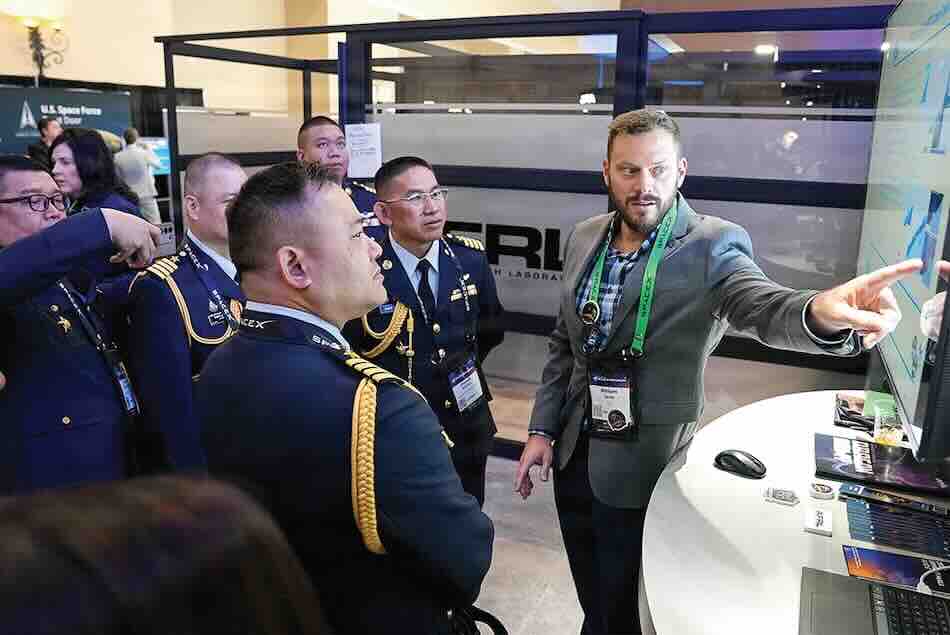
One new-era COMSO program designed to keep up with commercial space is the Space Force Front Door, a hub for facilitating collaboration with companies that seek to grow or share tested and emerging technologies. “We are working on identifying pathways to understand the commercial enterprise internationally, as well as the domestic enterprise,” Front Door Director Vic Vigliotti told Apogee. “We have helped inform the standup and the initiatives with regard to a NATO front door. We’ve talked to a few different allies and partners on identifying front door constructs across those partnerships, so we can see what’s available domestically but what’s also available internationally.”
You can see practice follow policy when commercial integration initiatives reach units on the ground, like the Space Force’s Delta 3, where Col. Eddie Gutierrez, deputy commander, helps lead an electronic warfare mission.
“There are three legs here: The operational side, the acquisition side, and the industry side,” Gutierrez told “Constellations,” a podcast from defense contractor Kratos Space. “If all three are humming at the same cadence, they all understand the same needs, and we’re all working toward the same goal, we’ll continue to win. Every one of my vendors that I work with are industry partners. They call me their customer, and I tell them I’m not a customer. I want to build a partnership. Partnership is key, that we’re all on the same team. And if everyone is focused on that, we can really move mountains.”
Working closely with industry partners made possible some rapid advances in two electronic warfare programs, Bounty Hunter and Meadowlands, Gutierrez said on the April 2026 podcast. Tasked with taking Bounty Hunter mobile quickly, “I understood what the requirements were, so I went to our industry partners, and we sat with them, and we did it. We delivered a remote-capable system in six months.”
The same approach moved Meadowlands up by a whole year, “sitting with our operators, our acquirers and our industry partners in the same room, all aligning our functions on the outcome ahead, which is delivering kit to the warfighter.”
Opening a bank account
The Space Force and SSC put money behind their commercial integration efforts with the establishment in October 2025 of a revolving working capital fund valued at more than $1 billion. Money from the program, called the Enterprise Space Activity Group, will help military users more quickly buy commercial satellite communications, outside the annual congressional appropriations process.
“This is really like a bank account that we can use to put customer dollars into … and then procure, for now, commercial SATCOM to the best of our ability and to make the most advantageous deal for the government,” Trimailo said. “In the future, we will expand that working capital fund into other mission areas. It’s just a really good financial tool for making efficient procurement of some of these types of commercial capabilities.”
Private investment in space defense is growing by leaps and bounds, at a time when venture capital overall is on the decline, said Rob Desborough, managing partner with London-based Seraphim Space, the world’s largest investment group dedicated to space technology.
Desborough has seen annual investment in the space sector overall rise from $1 billion a year when Seraphim started a decade ago to $18.8 billion in the past 12 months, he said during a dual-use panel discussion at the Space Symposium. Seraphim has overseen $12 billion in space investments, he said. “Eighty percent of our portfolio is dual-use technology, and the primary revenue driver is defense.”
Desborough expects that balance to even out as more commercial sectors find new ways for space to support their operations.
Commercial space startups are turning to space defense now because that’s where the money is, said Cindy Chin, founder and CEO of Planetary Systems AI of New York. Chin had her eye on space exploration when she started the company but soon realized that a single military space mission can account for more spending than NASA’s entire annual budget. Planetary Systems AI now works with government agencies including the Space Force, she said during the panel discussion. “The unit economics kind of make that decision for you.”
Technological advancements and government policy helped give rise to the booming commercial space sector, said Damon Feltman, CEO of the nonprofit Space Force Association and a retired Space Force brigadier general. “You can build a successful business around it now,” said Feltman, also a dual-use panel member. The cost of launch, a capability pioneered by the U.S. military through its ballistic missile programs, has plummeted thanks to the market-driven innovations of SpaceX. And the easing of restrictions, for example, on the detail that Earth imaging satellites are allowed to capture, gave rise to a thriving new industry.
SpaceX, whose revenues are strongly driven by defense spending, completed the largest initial public offering ever in June 2026, reaching a market capitalization valued at more than $2 trillion.
Mixing and matching
For the Space Force, commercial integration can take many forms — including modifications of the ubiquitous payload container known as a bus, Trimailo said.
“We can buy commercial services, whether that’s data or bandwidth or whatever the case might be. And we can buy that as a service. So, as a service means commercial owned, contractor owned, contractor operated.
“You can take commercial off the shelf. You can take commercial components, and you can modify those to be able to handle government mission sets. We can take commercial buses and modify them, add a solar panel, but use basically the commercial variant of a satellite bus and then integrate a government payload on that. We can take commercial payloads and integrate those onto either government, purpose-built or commercial satellite buses.”
Flexibility is key, he added — a concept not always associated with space defense programs of the past. “As we talk to either companies or government stakeholders, we want them to understand that we don’t have to cram these technologies into a specific predefined box. Anything that’s being brought to bear on the commercial side, we can integrate in some way, typically, into how we’re going to fight and win wars in the future.”
Another form of commercial integration for the Space Force is the Commercial Augmentation Space Reserve, or CASR, a program that taps into commercial capabilities through prearranged contracts with trusted partners during times of crisis or conflict — space warfighting, for example, or natural disasters. The services could include satellite communications; tactical surveillance, reconnaissance and tracking; and space domain awareness. The first CASR contracts, involving space domain awareness, were scheduled to be awarded in 2026.
CASR partners might be called upon to provide capabilities already in orbit, augment existing Space Force missions with added capacity, reach back into production lines to rapidly produce satellites, or deny service over a region.
“The key there is getting something delivered as quickly as possible,” Trimailo said. “Operational capability on contract this year, so that we can bring it to bear for the warfighter as quickly as possible.”