

U.S. military leaders have long touted partnerships with allies, commercial entities and academic institutions as fundamental to deterring aggression. At U.S. Space Command (USSPACECOM), this multipronged approach takes on greater significance, particularly when it comes to colleges, universities and academic organizations.
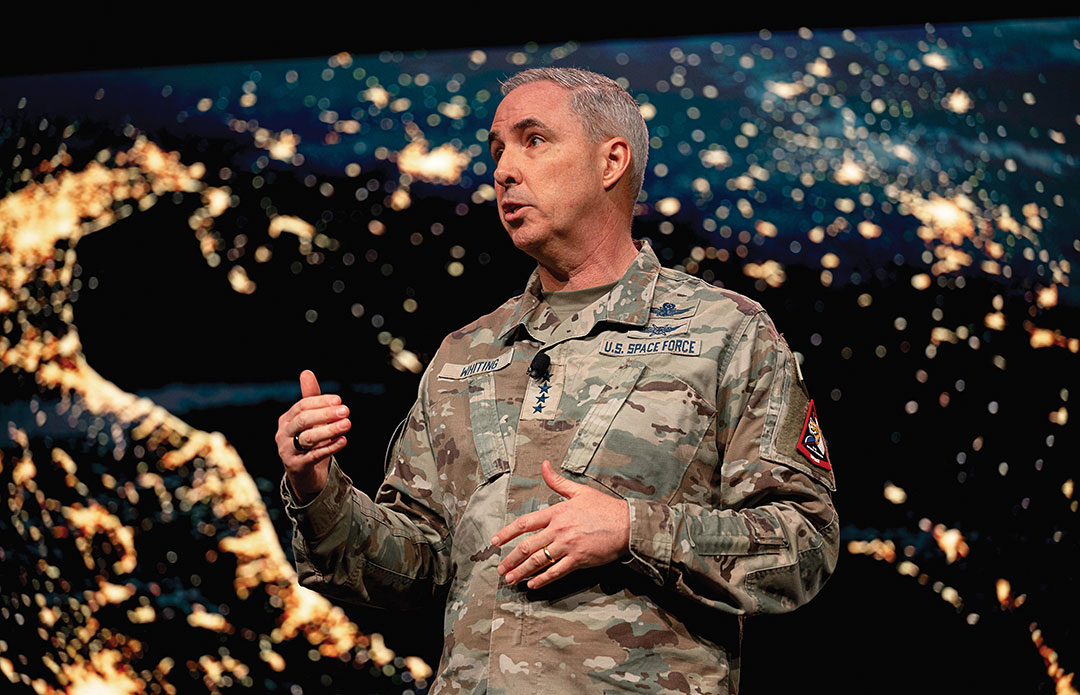
“Leveraging the collective strength of commercial, interagency and academic enterprises has been critical to USSPACECOM since its establishment 41/2 years ago,” U.S. Space Force Gen. Stephen N. Whiting, commander of USSPACECOM, told the Senate Armed Services Committee in February 2024. “It will remain foundational to our success moving forward, and its continued growth and development remains a key focus area for our command.”
This wasn’t the only time Whiting called for a collective approach. During a symposium in November 2024, he urged academic leaders to partner with USSPACECOM to help protect the nation’s space interests and shape its vision for the future.
“Amid the evolving landscape of the space domain, it becomes imperative for the academic community to help us determine what the future looks like,” Whiting told the educators. “With the convergence of civil, military and commercial space sectors, there’s a pressing need for visionary thinking to strengthen our national space capacity and technologies. Whether serving in one of the military services, pursuing a professional civilian career at the federal or state level, academia or industry, there is a place for everyone to shape the future of the space domain.”
Universities are answering that call, and in a big way. Driven in part by increased demand from industry and advancements in space, college engineering and aerospace programs are seeing significant enrollment growth. In the 2019-20 academic year, universities conferred roughly 7,600 aerospace and aeronautical engineering degrees, according to College Factual, a website that tracks enrollments. That number jumped to about 8,000 the next school year and roughly 8,600 for 2021-22.
Meanwhile, the U.S. Bureau of Labor Statistics forecasts 8% job growth for aerospace-related engineering and operations technologists and technicians through 2033 — faster than the average for all occupations.
As this talent pool expands, Whiting has called on USSPACECOM to strengthen outreach to academia as part of its Academic Engagement Enterprise (AEE) program launched in 2022 under the command’s J73 Joint Training and Education Division. Specifically, he laid out four goals for AEE in 2025:
Shape the space workforce: Inspire diverse groups of students to pursue careers at USSPACECOM and engage directly with universities to expand recruitment.
Accelerate space applied research and innovation: Connect academic research to USSPACECOM stakeholders and facilitate independent research and internship opportunities.
Explore, expand, connect space-focused academic and analytic partnerships: Collaborate with academia through exchanges, directed research and other engagement activities.
Continue to grow a space coalition: Dialogue with universities on space-strategic concepts to benefit current and future operations and identify opportunities for international academic engagement to expand allied and partner nation relationships.
J73 leaders say the goals come at a busy time, as AEE membership has surged. Since its first member universities were admitted in September 2022, that initial group of five has ballooned to more than 80 institutions — including Arizona State, Embry-Riddle, Penn State, Purdue, Texas A&M, William & Mary and Yale. The program was created under U.S. Army Gen. James Dickinson, then commander of USSPACECOM, to connect with academia.
Michael Madsen, branch chief, joint education at USSPACECOM, told Apogee the program has always enjoyed steady growth in membership, but admissions took off near the end of 2023. Over the next 18 months, some 50 universities and colleges joined the coalition. Several factors contributed to the surge, from the J73’s determined outreach effort to the influx of space-based companies and university aerospace and science programs over the past five years.
“I think the amazing thing that I have observed is that in the last year, just word of mouth, our universities in the network, the AEE network, are talking to each other and they’re talking to their friends at other universities,” said Madsen, who served 23 years as an Army officer and received a doctorate in management, homeland security, from Colorado Technical University. “And so, we have received phone calls and emails from people out of the blue, from universities that say, ‘Hey, we’ve heard about you, and we’re interested.’ So, we have informational meetings with them online and then, all of a sudden, the discussions about membership start.”
None of this would have been possible had the program not already made strides connecting with colleges. Top generals like Whiting have made a point of addressing symposiums and education roundtables as part of the command’s outreach goals.
This dovetails with AEE’s aim to facilitate dialogue. So far, the effort has paid huge dividends. “Every time we visit one of our universities, the students are very excited to talk to us,” Madsen said. “I think the message has gotten out in the last five years or so that space touches everything across our society, through the use of satellites for communication, for GPS and any number of other activities that support our communities and support our society, and so, they’re seeing opportunity there. These are incredibly bright, talented and intelligent students, and they’re seeing that they can get involved in numerous different ways to support the space industry.”
Providing research opportunities also helps bring educators to the table. Twice yearly, the AEE sponsors a symposium to facilitate dialogue with educators and students about research. Not everything at the events is military focused. Sometimes complex research questions arise concerning broader issues like low Earth orbit congestion, space debris and environmental impacts surrounding space flights.
“I remember being at a symposium with astronauts, with all these exquisite faculty members, and not once did they mention military constellations in space,” J73 Training Program Manager Anthony Wilson told Apogee. “It was all environmental issues, the space industry and communications. It was fascinating because you’re looking at this — and we know the different constellations that the Department of Defense, specifically Space Command, and our industry support — but it was like two different conversations. But guess what? When you’re talking about congestion you’re talking about impacts to space flight, you’re talking about issues that affect us all. So, I think that’s what was fascinating: two parallel conversations happening about research and activities in space, and I think that is what the AEE specifically is getting after, what Gen. Whiting stated, which is we must establish a collective strength between these types of entities.”
Amid the evolving landscape of the space domain, it becomes imperative for the academic community to help us determine what the future looks like. ~ Space Force Gen. Stephen N. Whiting commander of U.S. Space Command
While connecting with researchers is key to AEE, recruitment remains at its core. But outreach managers like Wilson have found that attracting the best and the brightest isn’t always easy, and sometimes a learning curve is involved when reaching out to students. Unlike the U.S. Armed Forces, which focus on Reserve Officer Training Corps (ROTC) and other programs to fill officer ranks, USSPACECOM relies on a workforce of military and civilian employees working in tandem. This can sometimes prompt questions from job candidates unfamiliar with USSPACECOM, such as, “What exactly is U.S. Space Command? Can I become a Guardian there? And, is it related to the Space Force?”
“I think when people hear about Space Command, they’re automatically thinking ‘OK, ROTC, a pathway to the military.’ Or you’re going to steer people toward the Space Force or to the Army or something,” Wilson said. “But there’s a whole wealth of civilian opportunities out there, and that’s what gets some of these students excited, too. They think, ‘Oh, wow, this is terrific. There might be some great opportunities here for me at the civilian level.’ So, does that also excite some people? Absolutely. And those are the people we attract. Some of those students that are interested … might have had a parent, grandparent, or an uncle or aunt that served, and so they also have that same desire to serve. That’s kind of our niche.”
Recently, the AEE reached out to community colleges, recognizing a need for entry-level workers who don’t have four-year degrees but nevertheless possess valuable skills. It’s developing a certificate program for non-degreed workers, as well, Madsen said.
At Embry-Riddle Aeronautical University in Daytona Beach, Florida, the AEE program has been a natural fit. When the program debuted in 2022, the university jumped at the opportunity to join. It already operated robust ROTC programs for the Air Force and Army as well as a Marine Corps Platoon Leaders Course for officer candidates. And recently, it admitted its first Space Force Guardians to the Air Force ROTC. In addition to Daytona Beach, Embry-Riddle has campuses in Prescott, Arizona, and on military bases worldwide.
“We’re always looking for the opportunity to collaborate with military leaders to ensure that our curriculum is informed not only by the needs of the commercial space sector but also the defense and security side of the space sector,” Rob Kelly, Embry-Riddle associate vice president of corporate and military relations, told Apogee.
“In some ways [AEE] validates some of the things that we’re already doing on the education and research side. We are constantly looking to the military industry to make sure that our graduates are ready to go and hit the ground running when they start work,” he said.
Keeping the lines of communication open with USSPACECOM and other military sectors has aided the university’s decision to introduce new educational programs, including two aerospace-related degrees.
“On our side, we’ve added a space flight operations degree in the Daytona campus to educate students going into the space domain,” Kelly said. “And then for our worldwide campus [including military bases], we’ve added a space operations and space systems degree, and that has been informed by talking to military and civilian leaders about needs out in the workforce, so [being a part of AEE] has benefited us in that way.”
The university also has hosted visits from Maj. Gen. Sam Keener, director of joint forces development and training (J7) at USSPACECOM, and Maj. Gen. Timothy A. Sejba, director of the U.S. Space Force’s Space Training and Readiness Command. In return, the AEE has welcomed multiple Embry-Riddle professors and students at its fall and spring symposiums, affording them an opportunity to collaborate with USSPACECOM leaders.
“We [USSPACECOM and AEE members] must prepare accordingly across all sectors of society to safeguard our collective interests in space,” Keener said at the Spring 2025 AEE Symposium in Colorado Springs, Colorado. “Although many challenges continue to confront us, there is also an incredibly bright future ahead for all nations in space if we work collaboratively to create it. But this is a future we must actively work to bring to fruition, and I’m proud to be a part of this community in which so many of us are dedicated to not only protecting our nation today in space but also preserving a stable and sustainable space environment for future generations.” Administrators at the University of Nevada, Reno, likewise are pleased with the institution’s AEE participation. The university joined the program in February 2024 — about a year ahead of its anticipated rollout of an expanded aerospace program at the College of Engineering. Vince Catalano, senior vice provost for university projects and initiatives, said the AEE seems tailor-made for Nevada engineering students.
“It provides an opportunity for our students to work in some of the most important and, frankly, cutting-edge areas of engineering and science that have a direct impact on these students’ daily lives,” he said. “I think very few people appreciate the role of U.S. Space Command in today’s environment, and so educating the students on the technological aspects I think it’s important.”
Among its cutting-edge offerings, the AEE recently published guidance for artificial intelligence and data learning, the AI/ML & Data Analytics Strategy 2025-2027, to aid military members, researchers and others.
“This strategy fulfills new national security policy and DOD guidance on harnessing and integrating AI models and AI-enabled technologies for all appropriate [combatant command] activities, missions, and processes,” Keener said. “AI/ML and Data Analytics are three overlapping and strategic areas of immediate consideration for the command.
“We are in a new era of profound technological transformation, so we must adopt processes which enable innovative thinking, rapid progress, and the ability to pivot quickly from outdated or obsolete systems and practices for new and modern approaches,” he said. “We cannot do this alone. Our academic partners are essential, as is the commercial sector where many of the revolutionary developments are first taking shape.”