

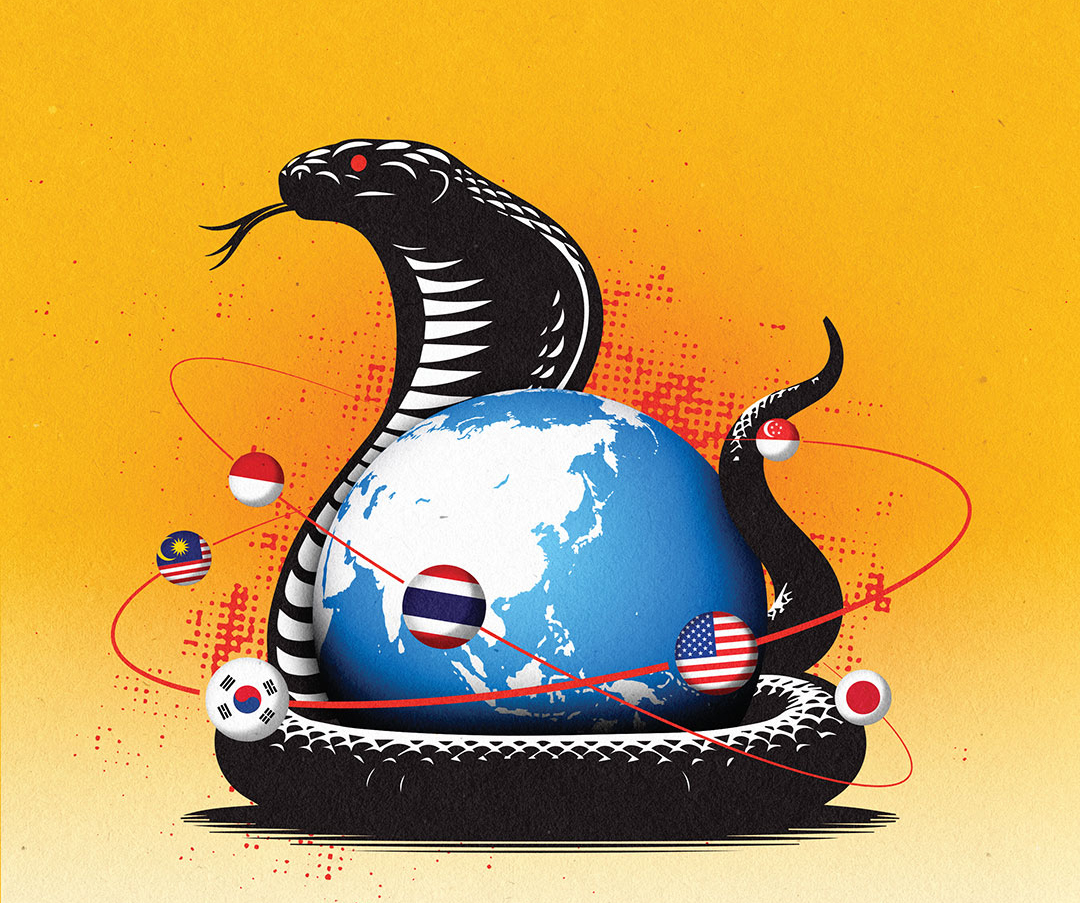
Joint Exercise Cobra Gold, a cornerstone of U.S. military engagement in the Indo-Pacific for more than two decades, highlighted the integration of space capabilities. Space has become a critical operational domain, and the multinational effort to enhance interoperability and strengthen regional partnerships is more critical than ever.
Cobra Gold 25, held February 25 to March 7 in Thailand, featured the space domain as its own component — rather than a subcomponent of another command — marking a “very, very special year” for the exercise, said Maj. Moises Rendon, strategy and plans division chief for U.S. Space Forces Indo-Pacific.
“This is only the third year that space has been included in Cobra Gold, and it’s been in a ‘crawl, walk, run’ operation,” Rendon said March 4 while on a tour of Korat Royal Thai Air Force Base, according to Stars and Stripes, a U.S. military newspaper. “This year is our first year of ‘run,’ and we have … made sure that space was its own component with its own multinational force.”
The 11-day exercise brought an estimated 8,000 troops from 30 countries to Thailand, including about 3,200 U.S. service members. The countries that participated fully in the joint multinational component command were Indonesia, Japan, Malaysia, Singapore, South Korea, Thailand and the United States. The exercise consisted of three primary events: a command and control exercise, humanitarian civic aid projects, and a field training exercise.
The goal is to establish a combined, joint multinational component command specifically for space.” ~ U.S. Army Maj. Garry Stratiev, space operations planner, 3rd Multi-Domain Task Force U.S. Army Pacific
Three other countries were limited participants: Australia, China and India. Australia was authorized to participate in the command and control exercise, staff exercise, cyberwarfare, and space events, while China and India were limited to humanitarian civic aid and humanitarian assistance and disaster response projects. An additional 20 nations were observers.
The U.S. Department of Defense (DOD) addressed China’s participation before the exercise: “Joint Exercise Cobra Gold is a very positive example of multilateral cooperation and stands in stark contrast to other examples in the region, which challenge the international rules-based order through expansive and assertive security actions.”
DOD “will work with the PLA [People’s Liberation Army] when our interests align, and when it can advance global priorities. Such dialogue between the United States and the PRC [People’s Republic of China], including open and substantive discussions between our armed forces, helps us maintain lines of communication and ensure that competition does not veer into conflict.”
Interoperability and partnerships were a primary focus of Cobra Gold 25, including in the space domain. “The goal is to establish a combined, joint multinational component command specifically for space,” U.S. Army Maj. Garry Stratiev, 3rd Multi-Domain Task Force U.S. Army Pacific space operations planner, said in a U.S. Space Command (USSPACECOM) article.
Many partner nations are in the early stages of incorporating space into their militaries, so a key objective of Cobra Gold 25 was to empower these nations to develop their space capabilities.
“A lot of countries we’ve talked to are still setting up their space operations, so they’re absolutely interested in partnering up and further enhancing their capabilities, expanding their opportunities to integrate space and learning how we do it, to set up their programs,” Stratiev said.
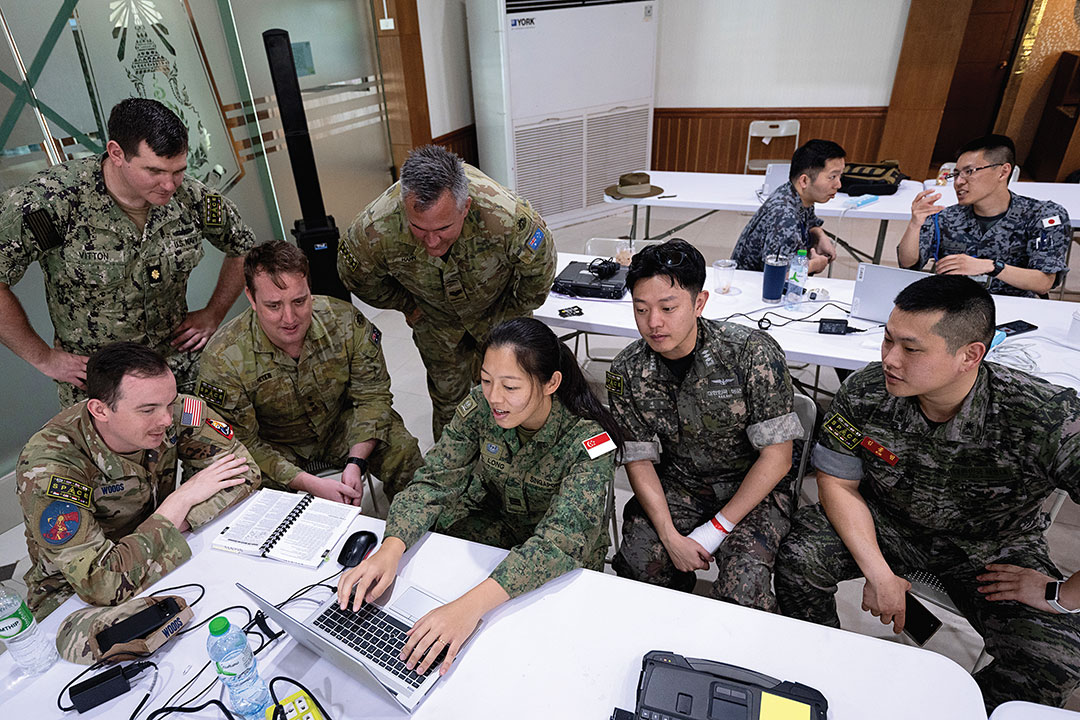
Space Operations Airmen from three Air National Guard units — two squadrons from Hawaii and a third from California — were part of a team deployed to Thailand to support Cobra Gold 25. U.S. Space Force Guardians from Fort Buckner, Japan, also participated. They all trained alongside partner nations, showcasing the role of space in modern military operations.
“The whole point of this is to show them what the Space Force can do for commanders,” Lt. Gabrielle Zamojski, a space operator for the 216th Electromagnetic Warfare Squadron in California, said in an article for U.S. Indo-Pacific Command (USINDOPACOM). “When we come out to exercises and show them different space systems, they can see what the electromagnetic warfare spectrum is and what the space link can look like.”
The United States brought two monitoring systems to Cobra Gold: Honey Badger and Kraken, which observe and characterize signals in space.
“The purpose of the Honey Badger is to monitor the downlink of satellite communications,” Space Operations Tech. Sgt. Michael Cornell said in a U.S. Army article. “Doing so can provide us with early warnings that can allow us to better defend ourselves and our allies.”
Kraken, meanwhile, is a portable device that detects signals associated with unmanned aerial systems — drones.
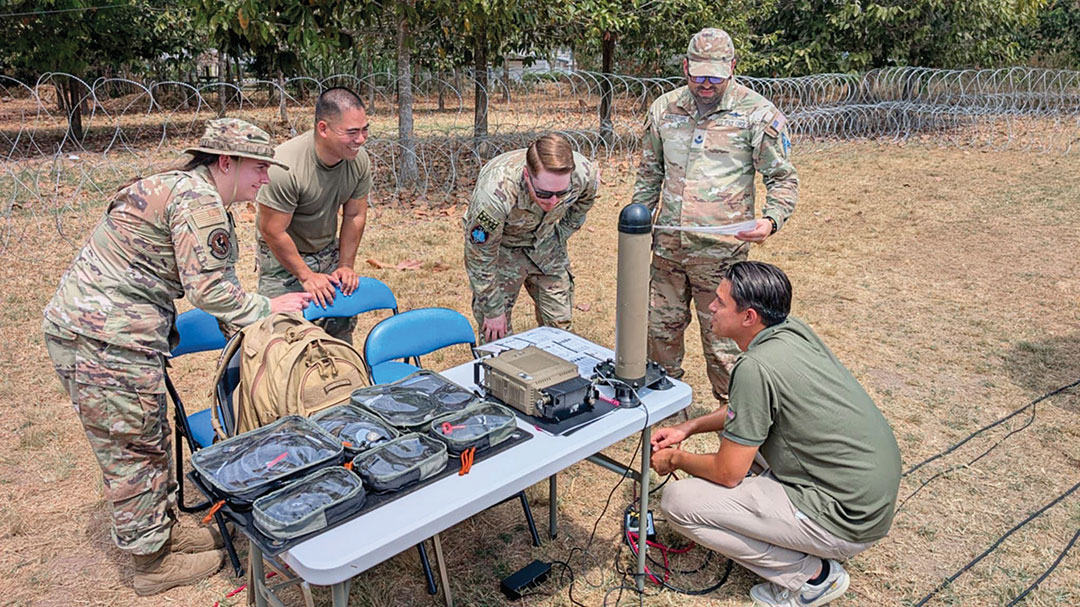
“This is the first time my unit has supported this exercise and we’re slowly getting more Space Force integrated into it,” Zamojski said. “We’re a new branch, and we’re plugging into more exercises to highlight our strategic value to our allies and partners.”
The training enhanced interoperability with partner nations and demonstrated the Space Force’s dedication to working with them.
“I am learning a lot about the space environment out here, and this exercise is a great learning opportunity for space operators to go out and integrate with different nations while working on different types of missions from what we normally do at our home units,” Senior Airman Michael Caravalho, a space operator with the 150th Electromagnetic Warfare Squadron in Hawaii, said in the USINDOPACOM article. “Once they see what we can do, I can explain in detail the type of work I am doing and how the systems work together to accomplish the overall mission.”
At another training event, a multinational team of cyber defense and space experts, including personnel from the Space Force, Army, Navy and Air Force, practiced guarding computer networks against simulated attacks throughout the exercise. Space experts focused on satellites and other assets beyond Earth’s atmosphere, while cyber specialists defended ground-based systems.
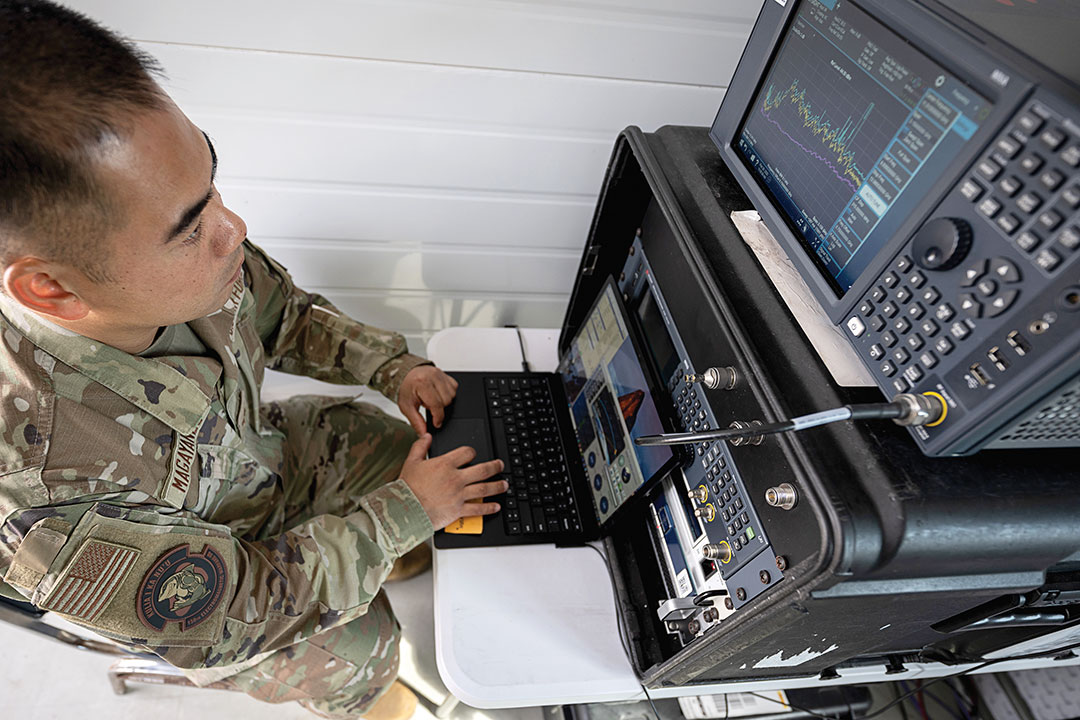
Warfare Squadron, calibrates the Honey Badger system for observing and characterizing space signals during Cobra Gold 2025. TECH. SGT. EMERSON NUÑEZ/U.S. AIR FORCE
The space component focused on improving communication and coordination among participating nations so they could “use the same systems and same organizational structure” for greater effectiveness in a simulated conflict, Rendon told Stars and Stripes.
As partner nations continue to build their space programs, they can match what they’ve learned from working with the U.S. Space Force, leading to increased interoperability.
“It is an absolute necessity to be able to inform our allies and partners of how we organize ourselves in terms of the space domain in the U.S., and also how we conduct operations,” Rendon said in the USSPACECOM article. “One of our goals is to make sure they have a baseline understanding of the military decision-making process and enough of an understanding of how we integrate space into that planning process.”
The space component of Cobra Gold also reinforces the “peace through strength” approach, with Guardians finding strength in numbers.
Cobra Gold 25 and the integration of space operations also underscore the U.S. commitment to a free and open Indo-Pacific. That commitment is gaining new importance as China and Russia militarize their space programs despite the 1967 Outer Space Treaty, which bans nuclear weapons in space and forbids establishing military bases, testing weapons and conducting military maneuvers on celestial bodies.
“A free and open Indo-Pacific doesn’t just mean that military piece; it also impacts economics, and especially because the Indo-Pacific has one of the largest economies and the most countries involved, we must be able to provide those capabilities free and open to all of our partners and everybody that might need it,” Rendon said. “Space operations are critical to everyday life, and we are helping everyone by showing them how to keep vital systems in place.”