


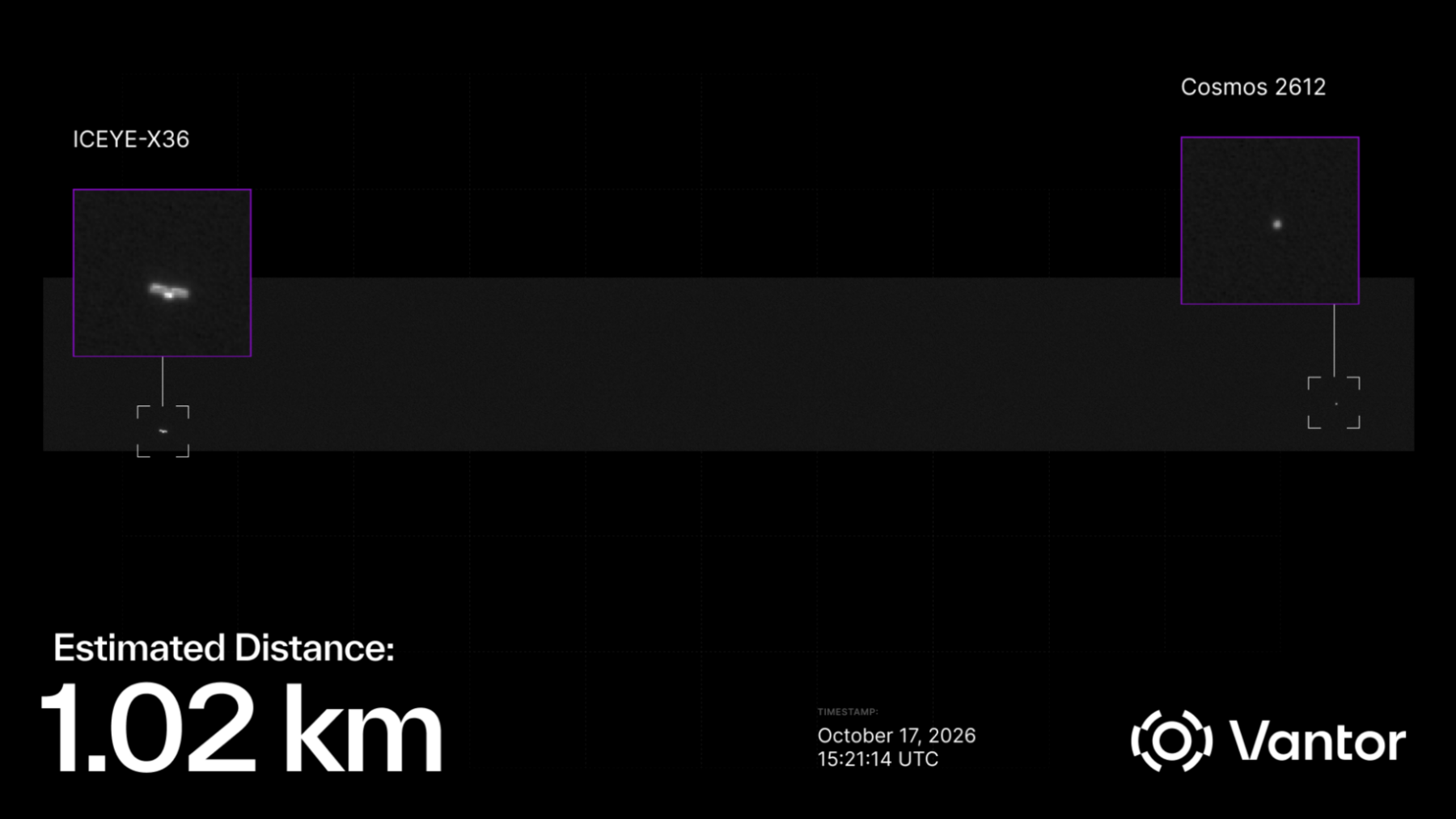
Between October 15 and 18, 2026, Russia’s Cosmos 2612 military satellite narrowed a gap of several hundred kilometers to come within roughly 500 meters of ICEYE X36, a U.S.-registered commercial radar satellite, according to space-tracking firm LeoLabs. Other public tracking data suggests the gap shrank to as little as 26 meters, though the precise distance remains unknown.
By October 18 and 19, Cosmos 2612 had started to drift, LeoLabs determined, ending the close-proximity activity. No collision or damage has been reported. Russia has neither explained the maneuvers nor disclosed the satellite’s capabilities, while ICEYE said it was “aware of the situation and [was] tracking it closely.”
The close encounter drew a sharp response from Washington. In an October 21 post on X citing an announcement at the UN First Committee, Under Secretary of State for Arms Control and International Security Thomas G. DiNanno described Cosmos 2612’s maneuvers as “threatening behavior,” stating the satellite had come “dangerously close” to a commercial spacecraft. He called the behavior “consistent with on-orbit weapons operations” and said it violated “long-established safety thresholds in low Earth orbit.”
Although the approach does not establish hostile intent, LeoLabs says it does demonstrate capabilities that could support intelligence collection, inspection, coercive signaling, interference—or lay the groundwork for future counterspace operations.
Clayton Swope, deputy director of the Aerospace Security Project at the Center for Strategic and International Studies (CSIS), told Apogee that the objective would be less to harm satellite services than to send a message. Disabling a single satellite would do little to diminish the service provided by constellations such as ICEYE or Starlink, he said. “But it would prove a point: that Russia can menace and harm Western interests in space without fear of the consequences.”
According to Swope, these actions are part of Russia’s broader “campaign of hybrid warfare against U.S. and European interests,” which he said is increasing in frequency and intensity.
How the approach unfolded
Beginning September 30, Cosmos 2612 spent two weeks aligning its orbital plane with X36’s and descending to nearly the same altitude, according to Swope and CSIS research assistant Chantal Li. The final approach began October 15, according to LeoLabs.
Matching orbital planes is among the most propellant-intensive steps in a rendezvous, consuming fuel that satellites carry in limited supply. Adam Marsh, LeoLabs vice president for technical solutions, underscored the operation’s significance, telling Breaking Defense: “This is the most advanced and potentially dangerous uncooperative RPO we’ve observed.” (RPO refers to rendezvous and proximity operations)
The stakes for commercial satellites
ICEYE’s radar satellites can image the ground at night and through cloud cover, making them extremely valuable to Ukraine’s military. In 2024, Ukrainian military intelligence said it had used an ICEYE satellite for almost two years; the Finnish company signed a new cooperation agreement with Ukraine’s Defense Ministry in January. Whether X36 supports Ukrainian operations remains publicly unconfirmed.
Moscow has said Western commercial satellites assisting Ukraine could be considered legitimate targets, a position that Russian Foreign Ministry official Konstantin Vorontsov argued at the UN First Committee in October 2022.
Yet a satellite does not need to be destroyed for its operator to feel the effects. Each defensive response burns propellant, disrupts imaging schedules and diverts engineers from threat monitoring responsibilities. ICEYE CEO Rafal Modrzewski told Reuters that the company had repositioned a satellite after an earlier encounter, prompting further Russian maneuvers.
The implications stretch well beyond ICEYE. German Space Command chief Maj. Gen. Michael Traut told Reuters on October 9 that Russia’s earlier shadowing of the company’s satellites demonstrated abilities that could threaten constellations such as Starlink. Satellites could be disrupted without a direct attack—a prospect that, “concerns me quite a lot,” he said.
Tracking and response
The U.S. Space Force and its allies track objects in orbit with ground-based radars, optical telescopes and commercial data feeds. Commercial tracking firms such as LeoLabs monitor these encounters as they develop.
Japan’s Defense Ministry plans a prototype by fiscal 2029, and Germany’s 2025 space security strategy calls for such systems as well. Traut told Reuters that Germany is currently developing inspector satellites and considering orbital weapons that could disrupt a hostile spacecraft without destroying it.
As these technologies grow more sophisticated, the rules governing their use remain unsettled. Swope sees a policy gap. “There is no real understanding of what is hostile, what is escalatory.”
DiNanno’s statement draws a firmer line, pledging that the United States “will continue to secure and defend American vital national security interests in, from, and to space.”
A pattern in orbit
The encounter follows earlier Russian activity near American satellites. Cosmos 2558, launched in 2022, was tracked in nearly the same orbital plane as reconnaissance satellite USA 326–a spacecraft U.S. Space Command said the Russian satellite could threaten as a space weapon, CSIS noted.
Writing on October 15, Swope and Li warned that policymakers should assume Cosmos 2612 could act against the commercial satellite. Moscow may be willing to accept that risk, they argued, if it believed the West would not respond forcefully. They urged the U.S. and Europe to respond assertively to any hostile Russian act against another nation’s satellite.