

India is pushing ahead with plans to launch a space station for human habitation in 2028, a milestone that would make it the fourth nation to do so.
The India Space Research Organisation is making rapid progress on the Bharatiya Antariksha Station as part of its Gaganyaan human spaceflight program, Program Director Imtiyaz Ahmed told the Indo-Asian News Service on February 9.
All told, India is working on nearly 80 satellites for scientific research, disaster management, security, navigation and Gaganyaan relays, Ahmed said. The ISRO previously had announced a 2028 launch date for the first module of a five-module space station that would become fully operational in 2035. The ISRO revealed the design of the station when it placed a model of Module 1 on public display during India’s National Space Day observance in August 2025.
The Bharatiya Antariksha Station, or “Indian Space Station” in English, would enable Indian astronauts to stay in space for three to six months, circling in low Earth orbit at an altitude of 400 kilometers to 450 kilometers. The Chinese Communist Party (CCP), Russia and the United States also have placed space stations in orbit.
The Bharatiya Antariksha Station highlights India’s growing ambitions as a spacefaring nation, said Namrata Goswami, professor of space security with the Schriever and West Space Scholars Program at Johns Hopkins University in Washington, D.C. “Around 2023, after India landed on the moon successfully, its confidence to do difficult missions increased,” Goswami told Apogee.
“India is a country that wants to be seen as a great power in space. Great powers have a few things,” she said. One is launch capability, and India is among the few nations with a heavy-lift rocket. Another is reusability, so India is at work on multi-mission rocket stages and a space plane. A third is a presence in low Earth orbit, which the space station would provide.
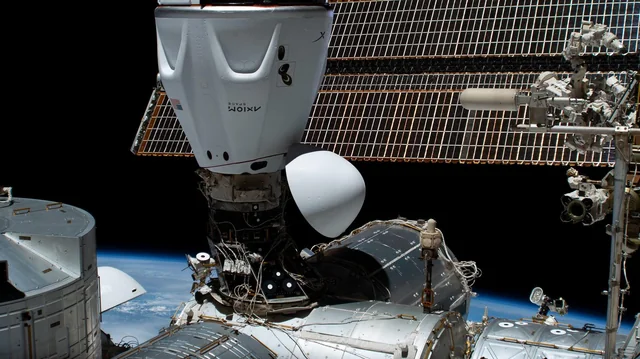
India is not among the 15 primary partner nations in the U.S. and Russia-led International Space Station (ISS). An Indian astronaut joined the ISS crew for the first time in June 2025. The ISS is scheduled to deorbit in 2030 after more than 25 years in operation. A commercial space station from Houston-based Axiom Space is designed as a successor to the ISS. The CCP operates a three-module space station, Tiangong, which could expand to six modules.
India also has announced a timeline for landing astronauts on the moon, with a target date of 2040. “Historically, when I was in India and did field work, Indian scientists would be very shy in giving me a date. Now they have a date,” Goswami said. Distinguishing India from other major spacefaring nations is its commitment to advance through indigenous capabilities. The CCP, on the other hand, has relied heavily on Russia’s pioneering work in space. India buys arms from Russia but distances itself from the nation when it comes to space, she said.
The Bharatiya Antariksha Station is being designed under international standards to enable docking and collaboration with global space agencies. The space station’s five sections are a base module housing crew quarters, a core module for docking and control, a science research module, a laboratory module and a common berthing module for cargo and crew transfer.