

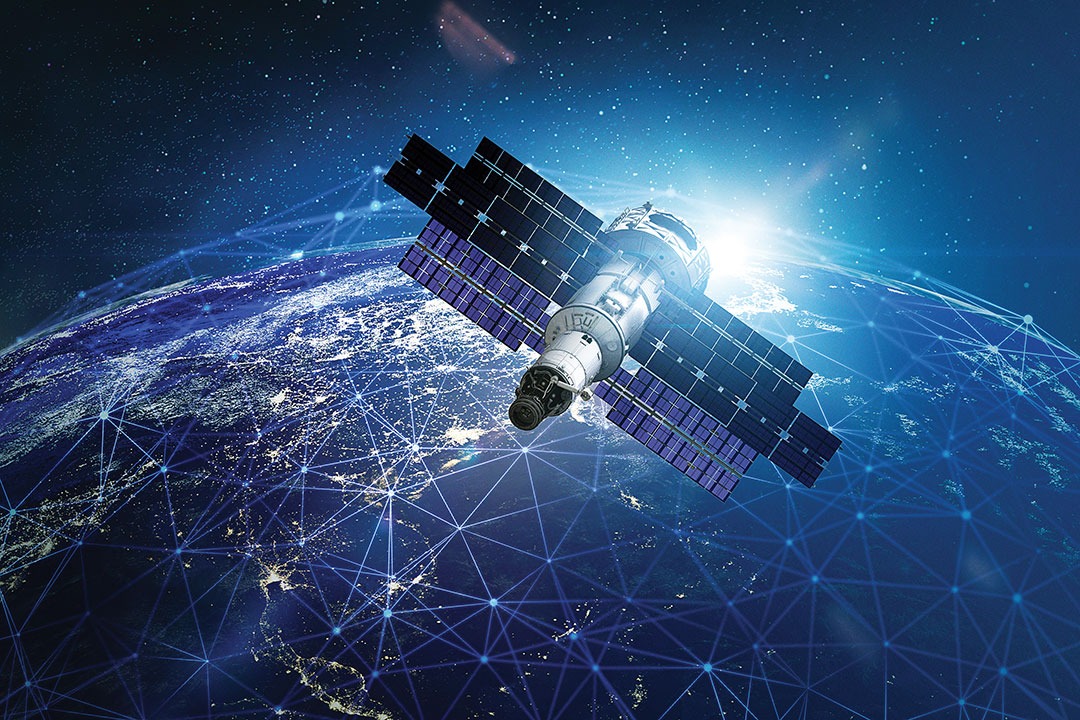
AFWERX, the United States Air Force’s innovation arm, is taking steps to deal with a big challenge in space defense — processing and analyzing the firehose of data from the growing number of man-made objects in space and their capacity to move and hide.
Through its Small Business Innovation Research program, AFWERX is funding the development of Slingshot Aerospace’s RAPTOR tool — short for rapid analysis of photometric tracks for space object identification and behavior recognition. Under RAPTOR, Slingshot will use machine learning to track, analyze and report to U.S. Space Command on the behavior of objects in low Earth orbit, the company said in an April 2025 news release.
Slingshot maintains a catalog of 14,500 active spacecraft and debris through its network of optical sensors, which generate more than 4.5 million photometric observations each night, the news release said. The resulting “light curves” create a unique digital fingerprint for each object that can be fed into Slingshot’s Agatha artificial intelligence model to spot changes like shifts in orientation.
“Establishing a comprehensive fingerprint database for all objects in orbit enables us to precisely identify an object’s nature and infer its potential mission objectives,” said Dylan Kesler, Slingshot’s vice president of data science. “By applying machine learning across our network, we can identify unexpected behavior and use those insights to support our partners’ defense missions.”
All satellites once followed stable, predictable orbits, but new technology enables them to conduct maneuvers beyond what’s necessary to avoid collision and to do refueling and repair missions in space. The Chinese Communist Party and Russia have been observed conducting stalking maneuvers in space, U.S. Space Force Gen. Michael Guetlein told a Washington, D.C., audience in March 2025.
As a result, the space domain awareness mission has grown more complicated, Kesler told Air & Space Forces magazine. “With many of the objects that we have most interest in, they’re highly maneuverable,” he said. “They’re getting near other objects, so it becomes difficult to distinguish them. And they’re increasingly using technologies because they don’t want to be seen.”