

Calls to develop a military presence in space grew louder at the turn of the century: “Create and sustain within the government a trained cadre of military and civilian space professionals,” urged one seminal 2001 report from a special U.S. congressional commission. It would be two decades before Congress created a dedicated service branch in 2019.
The new focus that the U.S. Space Force brought to military space training quickly touched off a broader evolution — across the Army, Navy, Air Force and Marines, and among armed forces around the world. The pursuit of space capabilities during the past five years can be seen in the way warfighters are preparing for the new domain through training and education.
“We went from two classes to 24,” said James Moschgat, director of the National Security Space Institute (NSSI) at Peterson Space Force Base in Colorado Springs, Colorado, an onsite and virtual schoolhouse that predates the Space Force by 15 years and now falls under the service’s training command. “I think it started with the advent of Space Force. When America started paying attention, everybody else started paying attention.”
Before that, few nations expressed interest in the sometimes-classified course offerings at NSSI. Access to the school expanded first to the nations in the Five Eyes intelligence alliance — Australia, Canada, New Zealand, the United Kingdom and the U.S. Now, 62 nations have been approved to attend at least one NSSI class, including nations in Africa, Europe and Latin America. “We’ve got tentacles all over the world now,” said Moschgat, who retired after 30 years with the Air Force as a combat pilot, wing commander and staff officer.
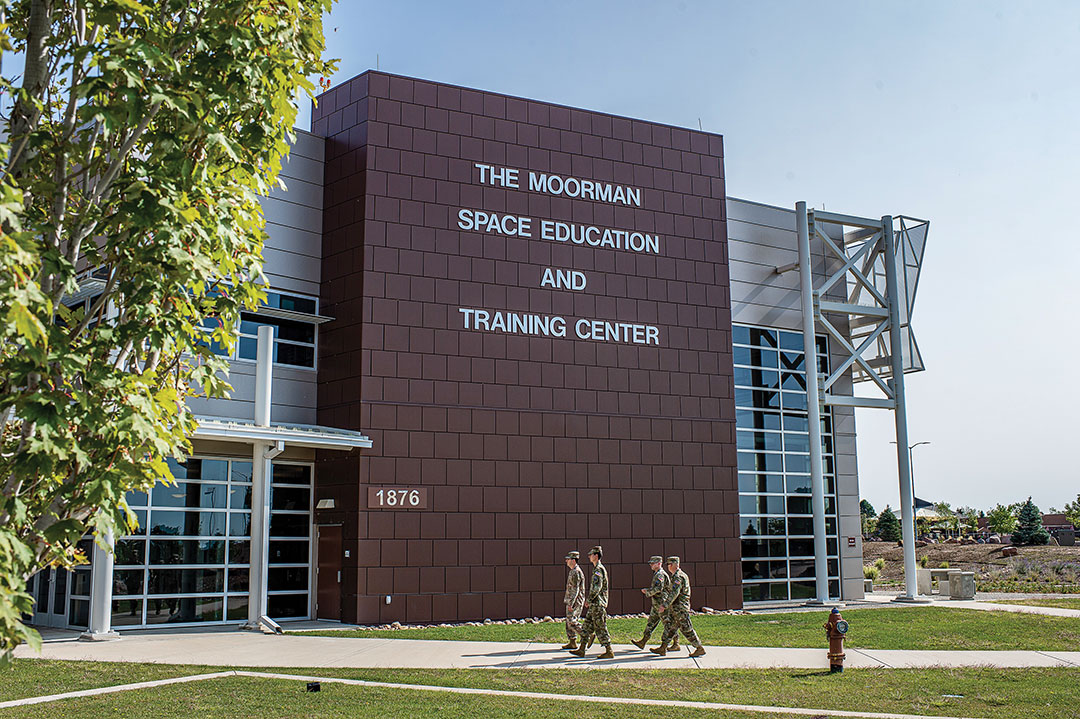
Among the most popular courses are a two-day space executive class for senior officers — “letting them dip their toe in the water of space” — and a coalition space course that explores space at the operational level of war. Some 18 nations have requested help through the U.S. State Department in setting up space training programs as part of their own developing space cadres, Moschgat told Apogee.
“We’re grooming people to think about the future,” he said. “With our international partners even, we look at what they can bring. So they don’t have the most robust space force with all the capabilities, but maybe they can provide a launch site that is very enticing. Or maybe they can help us with space control in some way. Or space surveillance.”
One example of training taking hold in other nations is the creation in 2023 of the French Space Defense Academy, a partnership among three schools — the National Higher Institute of Aeronautics and Space, the French Air Force and Space Academy, and the Space Operations Education and Training Centre of the French Space Command. The new academy provides a shared training framework, covering academic and operational aspects of space defense, the school said on its website. Attendance is open to French government ministries and other countries, as well as to stakeholders such as the French national space agency CNES, academia and industry.

“We’re grooming people to think about the future. With our international partners even, we look at what they can bring.” ~ James Moschgat, director of the NSSI
In addition, the Space Command of the United Kingdom, a branch of the Royal Air Force, is set to establish a space academy in 2027 at the site of the U.K. Defence Academy outside the town of Swindon, west of London. What’s more, South Korea is establishing a joint space education course for Army, Navy and Air Force personnel. The program includes master’s courses in space policy at the National Defense University; master’s and doctoral programs in space strategy, aerospace and astronomy from private Korean universities; and master’s and doctoral programs in aerospace science from private universities in the U.S. The plan also includes sending select captains and majors to courses at NSSI.
Partnering with allied militaries has long been fundamental to U.S. defense strategy, and the Space Force plans to build on this with the creation of the service’s new International Partnership Strategy, released in June 2025 by Chief of Space Operations Gen. B. Chance Saltzman. Among the policy’s highlights: Empower partners as force multipliers, enhance interoperability and information sharing, and create a more seamless multinational space coalition. Said Moschgat, “Because of the number we have, I don’t think anybody does more for building partnerships for the Space Force than the NSSI.”
Training expands
Still, the Army, Navy, Air Force, Marines and other U.S. agencies account for most of the 6,100 students who receive instruction each year through NSSI, reflecting an increasing reliance on space capabilities for warfighting. With some 100 instructors, the school provides professional continuing education at the 100, 200 and 300 levels supporting space cadre development and general space education for the broader Department of Defense (DOD). This follows a track different from the joint professional military education (JPME) that officers from the level of major to colonel receive at schools such as the Air War College in Alabama. JPME requirements are set by the Joint Chiefs of Staff.
“JPME is like the bricks and we’re the mortar,” Moschgat said. “We like to say that they’re a mile wide and an inch deep, while our courses are more a mile deep and an inch wide. We’re going to teach you a targeting course and we go into depth on targeting. Our space 200 courses are very much geared toward the operational level of war, and more geared to captains and young majors and tech sergeants and young master sergeants. We meet them at those points in their careers where we think they need this.”

in 2015. U.S. AIR FORCE
All the services can point to moves they made to develop space-enabled capabilities even before the creation of the Space Force, in areas including navigation and targeting. But the rapid advance of their education and training programs shows the urgency of the new realm. These programs prepare personnel in specialties representing a new dimension for services that were established to fight wars on ground, sea and air.
The Space Force was carved from existing services, chiefly the Air Force, but the Air Force retains certain space-related specialties, including those that fall under the heading of Space Systems Operations. Students in the Space Test Course at the Air Force Test Pilot School, for example, learn how to use satellite data and even how to directly operate a satellite, which they did from the ground for the first time during a session in May 2024 at Edwards Air Force Base in California.
The Navy has tagged more than 300 jobs as space related, all for officers, according to the Navy Space Organization webpage. These include maritime space officers who work within the information warfare community and are tasked with integrating joint space capabilities into maritime plans and operations. Many are assigned to U.S. Space Command (USSPACECOM), other combatant commands and fleet operations centers. The rest of Navy space falls within the space cadre category — officers qualified in space operations or space acquisition across 23 career fields who work in a space context at their primary warfare designation.

The Army and Marines have created military operations specialties (MOS) for some space-related jobs. Defending against ballistic missiles is a traditional Army mission that requires sophisticated space-based capabilities, and the service’s USSPACECOM component is the U.S. Army Space and Missile Defense Command (USASMDC). Four out of 10 Army space jobs are with USASMDC. For Marine enlisted personnel, space-related MOS titles include geospatial intelligence specialist, imagery analysis specialist, satellite transmissions system operator and signals intelligence/electromagnetic warfare technician. Each requires its own education and training track, and in most cases, a certification in the specialty.
So far, most of the Army’s 12,000 space-related positions — from combatant commands down to the company level — are for officers. But the service plans to expand space expertise across the enlisted ranks with the creation of an MOS titled 40D space operations specialist. The new job will ensure that enlisted Soldiers from specialist through command sergeant major will show up to space formations with expertise and experience in space operations, Lt. Gen. Sean A. Gainey, USASMDC commander, said in a May 2025 DOD news report.
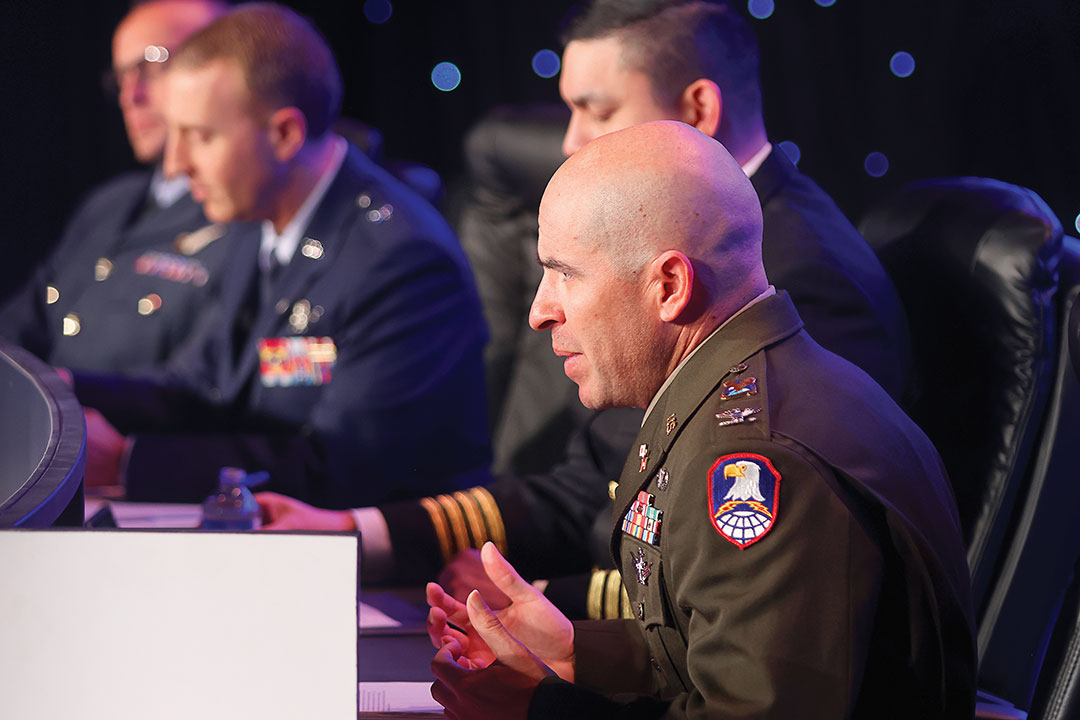
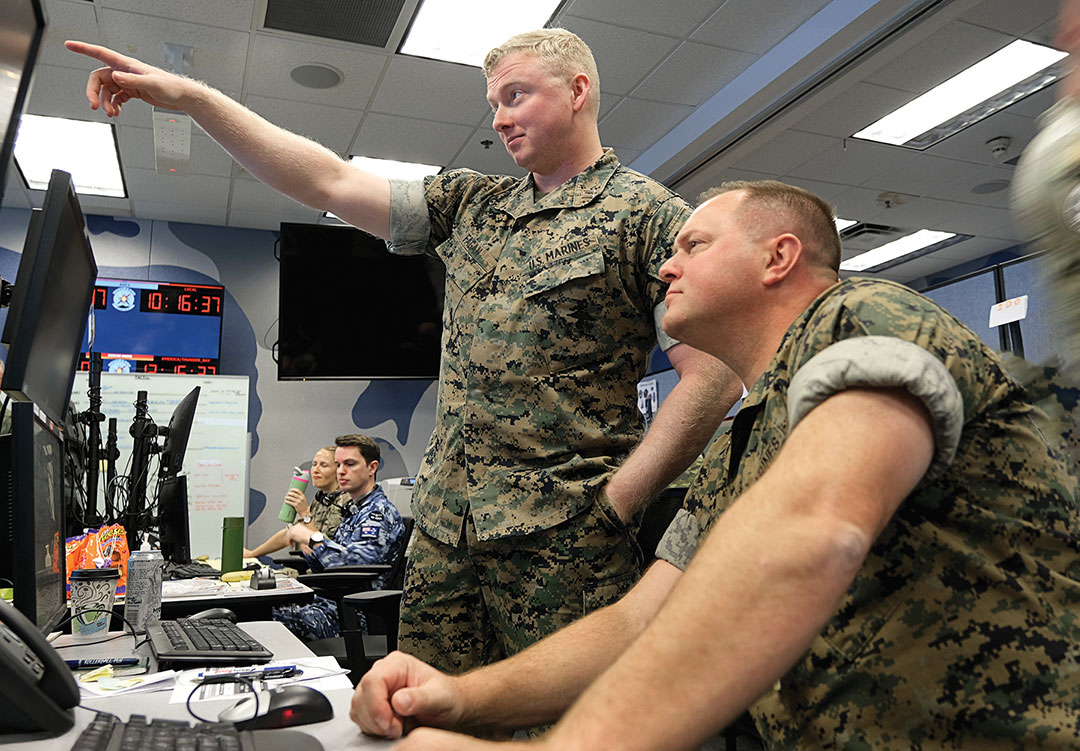
Once they have completed their initial entry training, Soldiers will be trained for the new specialty at the Space and Missile Defense Center of Excellence at Peterson Space Force Base. As with many of the Pentagon’s schools, students at the Center of Excellence include personnel from other services — the Navy, the Space Force and especially the Marines, who send students to each class, as well as an instructor in space operations officer qualification.
Soldiers and space
The center’s commandant, Col. Felix G. Torres, told Apogee that all Soldiers get some level of space training now, in part because they rely on space-enabled equipment that may be vulnerable to an adversary’s jamming. This includes a Soldier’s handheld radio, the Defense Advanced GPS Receiver or DAGR.
“I’m an infantryman on a squad maneuver, and all of a sudden my stuff stops working. What do I do? Some of the stuff we teach and train is how to mitigate that,” Torres said. “It may be that I need to block the adversary’s capability. It’s not the adversary going after a satellite, it’s going after the receiver. If you train the Soldier, they know the adversary is within the line of sight of your receiver. I need to go behind something or use something to cover my equipment so I can get my position, navigation and timing back.”
The Soldier also needs to know that the equipment will signal a jamming episode is underway, Torres said. “So, let me turn. ‘Oh, now it’s less. OK, so if I’m less and I go more and I’m being jammed, now I know which direction it is.’ So, then I can pass that information back to somebody else, who can start doing tipping and cueing and layering effects to go after whatever is out there.” He added, “Across the force, we’re making it our function for people to actually go out there and train in a denied, degraded, space operation environment.”
Soldiers who become specialists in space operations need to learn the basic lessons of war first, Torres said — the same approach the Navy takes in restricting entry into its space officer group to those making lateral moves at the lieutenant commander to captain level. “They’ve got to understand how their service fights first,” Torres said. “At some point, the fight is going to happen. I’m here to punch you in the face. That’s why we’re trained. Space is a warfighting domain. We treat it like a warfighting domain. We always have. We’ve never shied away from that fact. That’s the Army.”
With the creation of the new 40D specialty, and with other changes coming, the Army continues to update its space-related training, Torres said. “We have to remain relevant, to continue to upgrade our programs of instruction. We need to have virtual trainers, specialized equipment, scalable centralized warning management systems. Red tape? The idea of waiting two or three years to go back and forth and upgrade program instruction? That’s not going to work. As we teach a class, we take lessons learned from, say, the Russia-Ukraine fight, what’s going on in Israel. We start to integrate that into our education.”
Creation of the Space Force and space tracks within the other services helps stabilize career progression and retention of personnel and recognizes the complex nature of the training required — in line with recommendations from the January 2001 report to Congress from the Commission to Assess United States National Security Space Management and Organization. “Other career fields, such as the Navy’s nuclear submarine program, place strong emphasis on career-long technical education,” said the commission, chaired by Donald H. Rumsfeld, who at the time was between his terms as defense secretary for Presidents Gerald Ford and George W. Bush. “This approach produces officers with a depth of understanding of the functions and underlying technologies of their systems that enables them to use the systems more efficiently in combat. The military’s space force should follow this model.”
In recommending the creation of that “cadre of military and civilian space professionals,” the report also suggested bringing together far-flung efforts in space defense: “the U.S. Government … is not yet arranged or focused to meet the national security space needs of the 21st century. … (A) number of disparate space activities should promptly be merged, chains of command adjusted, lines of communication opened and policies modified to achieve greater responsibility and accountability.”
Does the expansion of space training and capabilities in military services beyond the Space Force represent a departure from this focus? For the Army, the answer is no, Gen. Gainey told reporters in May 2025. “There’s more than enough work for all of us on the battlefield today,” Gainey said.
Torres drew a distinction between warfighting on Earth, with the “terrestrial-based services,” and warfighting in space. “It’s a different fight,” he said. “The Space Force fight is not down on the ground. I think their focus is where it needs to be. Up there. The Air Force isn’t taking away our folks who do air assault. That’s us. We need to have the capability to fight when we need to at a time and place of our choosing. And that’s kind of where the close space support concept comes in for the Army. We’re going to have folks that get in real close and get out there and maneuver and know how to do it. Space Force isn’t that individual. Same thing with a maritime space operations officer, same thing with the Marines. They’re doing different things that involve space capabilities.”
He added, “My avenue of approach is space, but my target is on the ground.”
Torres noted that Space Force Gen. Stephen N. Whiting, USSPACECOM commander, has expressed appreciation for the Army’s advancements in space capabilities. “Gen. Whiting has said it numerous times. He comes to our Army senior leader courses, he comes to our space operations forum. We have those senior leaders come over for a reason. They say, ‘I love what you guys are doing. I want more.’”