


Like all those enrolled in the Schriever Space Scholars Program, Paul-Andre Johansen is both student and teacher — absorbing an elite military education while bringing to class the perspectives he learned during 20 years on ships and in staff positions with the Norwegian Navy.
Johansen, a lieutenant commander from Bodø in the mountainous coastal region of far northern Norway, is one of five international students attending the Schriever program for intermediate leaders and its associated West Space Scholars Program for senior leaders.
The 10-month programs, now in their second year, are a Washington, D.C.-based partnership between the United States Space Force and the School for Advanced International Studies at Johns Hopkins University. This year’s international students come from Brazil, Canada, France and Italy, as well as Norway.
Johansen served with the Royal Norwegian Navy aboard Skjold-class corvettes — six light, superfast, stealth-missile boats with a crew of about 15. Skjold means shield in Norwegian. Johansen was nominated for the Schriever program, in part, for his interest in applying space capabilities to his work with the Navy. He points proudly to his nation’s cooperation with the U.S. in space, including an agreement adding a U.S. Space Systems Command satellite communications payload to a planned Space Norway launch in August 2024, saving the U.S. up to $1 billion.
Military service is required of those who qualify for it in Norway and typically lasts about 19 months. But service there is viewed as a desirable career path, so about one-quarter of conscripts opt to remain in the armed forces. The next Schriever/West class also will include a student from Norway, who has benefited already from some of Johansen’s advice.
Johansen has found Washington to his liking, with its many parks and natural areas. “I’m kind of an archetype Norwegian; I like hiking,” he said. Also, his classmates have treated him to his first U.S. football game. Johansen sat down for an interview with Apogee after a morning jog around the National Mall. His answers have been edited for length and clarity.
What path did you take to enter the Schriever/West space program?

Back in my home country, we usually serve staff service at tactical levels and then we go to staff college. So when I was applying for staff college, the opportunity came to apply and compete for a place here at Johns Hopkins and their space scholars program. We did not know a lot about it. It was fairly new. But we thought this opportunity was great because it gives us in Norway the ability to get more experience on the space side of operations.
We work a lot together, our two countries. Norway and the United States. We do have a lot of exercises together and it’s interesting to come over here and see your system, kind of from the inside, and know each of the colleagues working over here. And see how the world looks from your perspective. It’s been a very good opportunity to learn, to broaden the horizon.
Is space your specialty?
I have a naval background. I came from our surface fleet and then I went into our joint headquarters as a staff officer. Joint planning is my background.
How do you think this space-focused experience will help you?
I think it will do a lot for the work ahead. You could say that times are changing, with the focus on the space domain, space awareness increased. So coming here, learning about the space domain, and learning a language by which to communicate on issues within the space domain is very valuable. When I go back home to continue in staffing, I’ll be able to more efficiently communicate what are our problems, what are our challenges, how do we interpret what our allies and partners are doing. Because we don’t have a common language to speak about it. That’s very useful.
How might your lessons help you in planning and operations?
The system you’re learning here to plan by, tied into the wealth of background information on why it’s built the way it is, is giving me real tactile tools to actually use for planning. I’ve done some planning before, and it’s interesting to see things systematized here — things you might have learned by doing earlier, but it hasn’t been vocalized. The theory is cool because it does make a difference and you can see that it works. I think it will last me much of my career.
Can you tell me about your military history?
I joined back in 2006. In Norway, we have military conscription. I joined in as an airman, actually, and I served for a year before I applied to the naval academy. Then I went to the naval academy for some years before being trained as a navigator. I was assigned to a fast surface attack vessel, part of our surface fleet, where I served for almost nine years before I went into operations and planning as a staff officer. During that time on the vessel, I filled different positions, so I got more of a broad approach to areas different from navigation.
How many ships in those years?
Just one class, but several different hulls in that class. Almost all of them, I think. I changed to staffing after serving as XO (executive officer).
Does Norway have a component anything like the Space Force in the U.S.?
Not currently. We have the Air Force, Navy, Army and the Home Guard. We have cyber defense, logistics and so on, supporting that. We have some communications satellites for defense purposes, launched in cooperation with the United States. I understand the U.S. is looking for more allies and partners to increase their efficiency. Other than that, I would say it’s a very new and exciting domain.
My background was lacking in the space domain before I came here. I have to say the school and program have done an excellent job in teaching both the language and models used to interpret this new domain, but also teach us how interconnected it truly is with all the other branches. We see that space is necessary for almost every avenue of our daily lives. We also are realizing that having such an integral part of the infrastructure in the space domain, we will need to be able to secure such infrastructure.
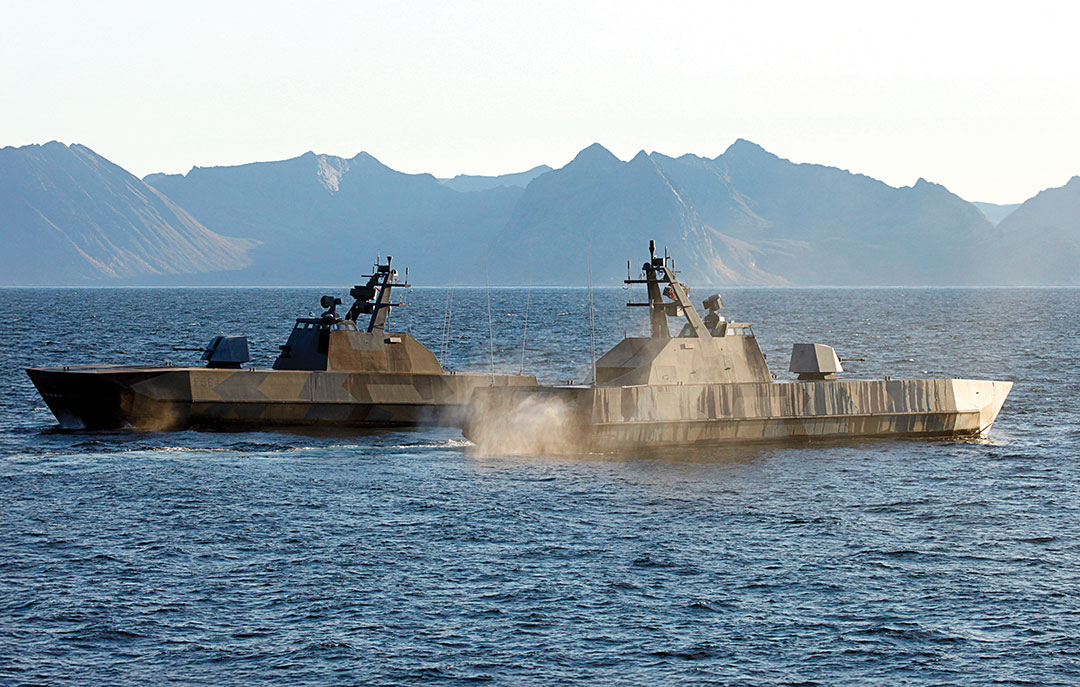
on to a staff position. KONGSBERG
Have you taken advantage of other military education before?
Norway has an exchange program with our allies. I have participated in a program basically focused on surface operations that was conducted in Denmark. There are different programs ongoing to build a force structure where you will always have someone in your unit who has had dealings with other entities before, so you have the knowledge of how to quickly and efficiently communicate.
Does Norway’s Navy have exchange programs with other nations?
Britain and the United States, and others.
Will your assignment change when you return home from this program?
My position will probably not change based on the experience I have here. I’m learning a lot about the interconnectedness of space and the language models around which to systematize space. I think that might be something I largely focus on when I get back home, to increase awareness around this interconnectivity — increase awareness in the Army, Navy, Air Force — on how the usage of the space domain and the knowledge of the space domain influences the actions and planning of every single branch.
Do you think there will be more participation by Norway in the Schriever/West program?
Yes, I hope there will be more. I hope there will be many more. I believe we are sending one student next year, as well. It’s good to hear because I think the program is very valuable. We are producing competency and knowledge about space. Having more people understanding this would probably increase the rate at which we are able to pass on knowledge to keep educating our own in the same system.
Norway is a founding member of NATO, and near neighbors Sweden and Finland have joined as the newest members. What did you think of this development?
It’s a bit outside my scope to speak about that, but it’s truly wonderful that Sweden and Finland have joined NATO.
Have you taken part in NATO exercises?
Yes, several. Because we are well-integrated with the NATO structure. So we conduct regular exercises facilitating training for the other allies to increase awareness, usually in winter warfare, exploiting the conditions which you can find in the High North. And using this as a force multiplier for the alliance. It’s interesting times, and a lot of things are changing rapidly. Doing programs like Schriever, sending our people here — the United States has 60, 70 years’ experience in space. To be able to draw from that experience is a great opportunity.
As you near the end of the program, are there main lessons you will take away?
Well, I think it’s important to not be overwhelmed by the information load. Try to take a step back and see what is the actual message, what are we actually being taught. Getting an overview of the material before you dive back into it to learn the details. I think the program has facilitated the opportunity to do that in a very good way. One thing I’ll take back is that it’s important to be aware there is always information available, but being able to put it into context and utilize it when it is needed is perhaps the most valuable lesson.
How did you decide which electives to choose here?
There is an ocean of opportunities. The good thing is even if you think you want something, and get something else, you’re getting something really good. I really appreciate the amount of electives to choose from because I thought I could choose something that would be useful to me as a staff officer. I could use and choose and build according to the needs I thought would be useful back home.
What electives are you taking?
First semester, I chose to focus on critical infrastructure and cybersecurity. I also had the opportunity to study bridging the gap between engineering and policy. This semester, I’m in the governance class, which I’m really enjoying because you get to know the complex system of laws and regulations trying to govern the domain. These things are very important because they are real. They exist. You need to be able to account for them. And I’m taking one final course of defense analysis.
What is the topic of your research paper? Are you working on it now?
Actually, I’m working on two. One is on how Norway’s new northern spaceport could affect space policy in a changing space security environment. It’s an interesting thought experiment.
Part of the appeal described for Schriever is you are learning alongside students who are military, nonmilitary, Johns Hopkins students. Is this variety proving to be a benefit for you?
I have to definitely concur with that because, being a Norwegian, I’m kind of adding to that diversity. I think it’s very helpful and valuable to have such different backgrounds together in such a program. Simply because having different backgrounds enables us together to see things from very different perspectives, to build more holistic plans, see things from different points of view, change perspective with the situation.