

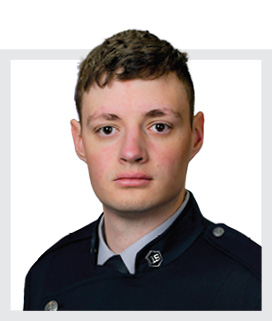
Dillon Kinsey is used to speaking before groups, starting with the briefings he gave as an analyst and now as an instructor and course developer with his U.S. Space Force squadron. Nothing before, though, was quite like the group he addressed one morning in April 2025 — 2,000 people representing the world’s top space interests at the 40th Space Symposium to hear him introduce speakers such as the U.S. chief of space operations.
Just 22, Spc. 4 Kinsey had been hand-selected from his work at Peterson Space Force Base across town in Colorado Springs, Colorado, to serve as a moderator during the annual symposium, billed as the premier event uniting global space professionals from all sectors. He was selected as a young ambassador for a service still in its infancy, where — in his view — every step forward seems new.
Kinsey sat down with Apogee for an interview before he took the stage, describing the unique opportunities and challenges the Space Force faces in training its Guardians. For Kinsey, the path here started in high school when he scrawled out “Mayor of Mars” as his plan for the future and a neighbor suggested in jest the Space Force as a stepping stone. Kinsey’s three years with the 5-year-old Space Force has included three different squadrons, a stint in Europe and an internship with the National Geospatial Intelligence Agency.
Starting in geospatial intelligence, he expanded his expertise to include signals intelligence, open source and all-source analysis — skills he used to inform commanders and warfighters across the Department of Defense. Today, he develops and instructs qualification training for the 74th Intelligence, Surveillance and Reconnaissance Squadron (ISRS), including lessons for the blue, or defending force, and lessons about red adversary forces.
This interview was edited for length and clarity.
You have a variety of experience considering your time in the Space Force.
I am what I think the Space Force hopes to develop, if I’m not mistaken, a jack-of-all trades Guardian. They want us to be able to do anything.
And you’re involved in training.
I was selected to be an instructor/course developer. Our squadron has been in the process of establishing its training program to initially qualify analysts for their job duties. Due to the experience base I have, I was brought on as the first junior enlisted on the training team to help develop and instruct the training course.
Can you tell me a little about how you work as a trainer?
Because we’re building this from the ground up, it’s a lot different from those codified programs in the Air Force, the Army, and other services. We have to tackle problems ourselves, without a lot of foundational resources to build off of. Our team has worked together to develop innovative training to get after specific fundamental knowledge needed by 74thISRS and Space Force intelligence analysts.
What is it you’re teaching?
I could go on a very long talk about what I actually teach, but the basic premise is that we are teaching the skills needed to perform as an analysts within the 74th ISRS. We’re doing the best we can to lay a foundation regarding resources, tools of the trade, analytic tradecraft, as well as mission area information. What that means is we’re just giving students the holistic idea of, “Okay, what do you need to do as a member in the 74th?” So, we go over what each delta does. Orbital considerations like fuel. We go over orbital mechanics. We develop all of that about the blue, then we teach about the red. And we collaborate in a capstone where we bring in everything they’ve learned, about writing, briefing, to an all-in-one product that measures the success of your learning. The curriculum will constantly change, as our mission set evolves.
You were tagged for training because you have a talent in the area. Do you think you’ll stay?
I hope I was picked because I have talent in the area. The members on my team are very talented. When it comes to instructing, it’s a lot different than briefing. Briefing you get up and you say what’s on the slide and that’s it. Instructing, you must break down the topic, ask questions, dig deeper, and get the students out of that comfort zone. I was told I was a good briefer but when it comes to actually breaking the lesson down, reaching those students over and over again so that they really understand what’s going on, it’s really labor intensive. You have to really dig in and make sure they understand, which makes it a fun challenge compared to briefing.
It’s the nature of teaching, right?
Yes, because inherently you have the ones who want to learn and the ones who don’t. And you have to make sure that everyone learns. Having that face time with everyone and still meeting the timelines. I’ve heard that if you don’t care about something, you have about two hours of work a day you can do before your brain stops retaining information, “caring.” Breaking that barrier down, for an instructor — the tools of an instructor are quite different than for briefing.
How long have you been an instructor now?
I started back in November (2024). So, three or four months now. It’s a very quick learning experience. I like to think I’m a very quick learner.
How long do you think this duty will continue for you?
I’ve had a unique career. Because all these moves were still in the Peterson area, I have not formally PCS’d (permanent change of station) yet. So, my “timer” has not reset. Going off that next summer, would be when I change my duty station.
Do you hope to continue in a training capacity?
It’s hard to say. Because my career has been so diverse, I haven’t been able to just pick one thing and say I like doing it. I’ve been all over the world and done multiple things, so it’s hard to say whether sticking to one thing will burn me out or not. My main ambition is supporting the Space Force in every way I can. I’ve taken part in a lot of experiences that I’m grateful for.
What can you say about the students you’re instructing? At what level do they come in?
Overall, experience levels vary widely. At the 74th ISRS, we are standing up qualification training, but our members have been doing the mission since the squadron stood up in 2022. With that, we have Guardians who have worked space intel for decades, and some who are brand new. To make sure we rebaseline everyone to the same knowledge level, all current 74th ISRS members will take this training. In the future, it will be just those who are new to the squadron, but at the moment, we’re re-training everyone in the squadron. This method helps us make sure we are leveling the playing field and establishing common ground among Guardians with diverse backgrounds. In the future, new members will flow through a variety of other training courses, take our QT course, and then proceed to their sections within the squadron for job-/duty-specific training.
Why is this type of training important for Guardians?
Truth be told, currently the initial tech school training that Guardians get isn’t really geared for the Space Force. I graduated a few years ago so some things may be different. But when I went through tech school and basic training, none of it was related to Space Force. It was Air Force tech school. Everything I learned in tech school is something I’m not using in my Space Force career. We need to make the Space Force training relevant. This is that first push for relevant training.
Are your students enlisted members?
It’s every member in 74th, enlisted and officers. Because the 74th is a squadron, it’ s a lot smaller in scope compared to most military units. The unit stood up a little over two years ago.
Do you find that daunting, with, say, a captain in class?
It depends. It’s more about the individual, and their experience. In Space Force, a lot of people don’t have space experience, so a lot of times you’re more knowledgeable than more senior personnel. Even when they are more experienced, that means I get to learn, which is a win in my book.
Can you speak to how it might be different to train troops for space operations than it would be for any other experience in the military?
Most of the other branches already know what they’re teaching. When it comes to space, the landscape and our understanding of it is always evolving. Most of the other branches are focused on figuring out how they’re teaching information, not what they’re teaching, unlike the Space Force where we are learning both at the same time. It’s also constantly evolving. We had lesson plans that were outdated two months after creation. For competency, you really have to stay on top of the game. Otherwise, you’re going to be teaching about something that doesn’t exist anymore.

Guardians in the public perception are seen, in part, as “console jockeys,” fixed intently at their computers. Is there truth behind this image? Do you work to change that?
I don’t think we should be working to change it. I don’t see anything wrong with it. I like to see the military as a car, every unit/mission is a different part. The car wouldn’t work if all parts were the same. So just because we aren’t the wheels doesn’t mean we aren’t useful. We are the electronics/computers in cars. We didn’t need them in the past but now they enable cars to be more efficient and capable than ever. It’s an edge we cannot afford to lose. So sure, a lot of us work behind computers, but it requires a lot of discipline. To show up for work every day and do better than the previous day. When it comes to being a console jockey, unfortunately, that may carry a negative connotation. But the more you learn about it, the more your perception will change.
What else should we know about training in the Space Force?
I think that because the Space Force is always evolving, training is never going to be solved. It’s going to have to be constantly built upon. Because of that, it makes it a more unique situation than other training.
In other service branches, individual success is often measured in accomplishments such as kills. For a Guardian, how do you measure that highest achievement?
I think it’s a lot different because we don’t have that heritage built up of, “Hey, this is how you celebrate success.” For example, my friends in an Air Force unit say that whenever something successful happens, they ring a bell. We don’t have that heritage. A lot of people are trying to build that heritage.
So, I think it depends on the member. I get satisfaction because I’m proud of the work I do. Whenever I do a good job, I just have a sense of pride, even moreso when someone recognizes the hard work done.
In the Space Force, there is no previous groundwork. A lot of the Space Force is being built from nothing. I get satisfaction from building that direction. I don’t think it’s a good idea to pigeonhole/compare our way of measuring accomplishments/success to how the other branches measure it.
Do you find yourself encouraging others to join the Space Force?
I love the Space Force but, I think it depends on what the person wants. If you want to be told how to live and breathe, I recommend another branch. But with the Space Force, in many cases you’re given the freedom on how you want to accomplish a task, so if you find enjoyment from problem solving, feeling satisfied when you’ve finished a hard task, building that foundation, I think the Space Force is the job for you.
You’ve got to be hungry, have curiosity, and want to strive for success. You’ve got to deal with building the road as you walk it. The Space Force gives you all the tools to build it but you’re coming up with the instructions. It’s the growing pains for a new force. Even though it’s been five years, it sounds like a long time, but it’s a very short time, especially with the processes establishing a branch.
The Space Force is very open and encourages people to do things their own way, whereas other branches often have the instructions down to a T.