


If you’re a military unit looking to develop your skills in space warfare, you can hire some crack squadrons based in Colorado Springs, Colorado, to mount a campaign on your behalf. The target, though, won’t be your adversaries. It will be you.
Some of these United States Space Force squadrons carry the title of aggressors, but they’re also professors. Through exercises and other means, they act as the adversary — the Red Team — to help Blue Team customers hone their skills in the space-enabled capabilities that are playing a growing role in modern warfare. The customers, both U.S. and international, range from individual units that may need a day’s training to multinational forces that drill for a month.
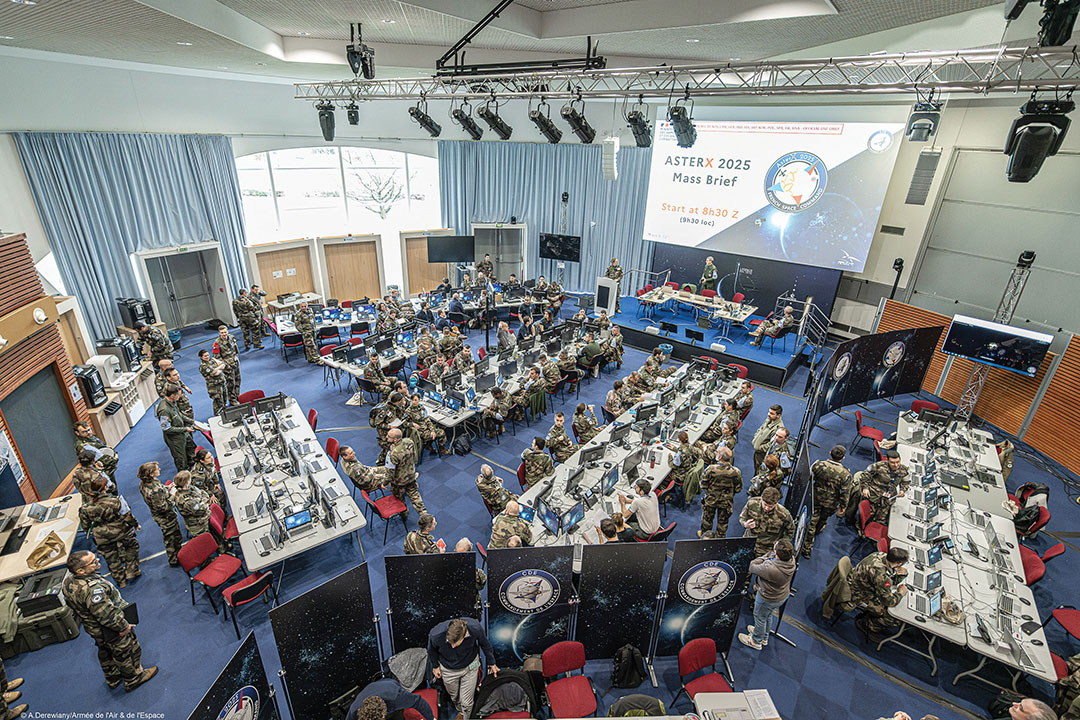
Members of the 57th Space Aggressor Squadron (SAS) from Schriever Space Force Base in Colorado Springs helped play the adversary during one of the biggest space defense exercises outside the U.S. — the two-week AsterX event held in March 2025 in Toulouse, France. Organized by the French Space Command (CDE), this fifth edition of AsterX drew an estimated 170 participants, including military personnel from 12 partner nations, the CDE said at its website.
The 57th SAS was “involved in providing a thinking adversary that forced participants to respond to realistic, adversarial challenges,” according to a report at the website of the Space Force’s Space Training and Readiness Command (STARCOM). The squadron is one of seven comprising STARCOM’s Space Delta 11. The Delta’s mission: deliver “realistic, threat-informed test and training environments through the provision of live, virtual, and constructive range and combat replication capability.”

Capt. Haley Slack, one of about 25 members in the 57th SAS, took part in AsterX, employing some of the tools her squadron relies upon and layering in others used by “our combined-arms partners.” One tool is known as ROTS, for Relative Orbital Trajectory System. “We use ROTS to help us simulate the orbits and the trajectories of our satellites so that we can mission-plan very quickly,” Slack said during a presentation at the April 2025 Space Symposium in Colorado Springs. “We’re a very small team. In order to plan very quickly, we use ROTS to help us out with the timing and tempo of our exercises.”
The work of the Red Team “allowed for a highly dynamic and uncomfortable scenario for our operators, with a view to pushing them to explore their limits,” the CDE said in a report on its website. During AsterX 2024, a foreign entity — the U.S. Space Force — took on the role of the Red Team for the first time. Exercise scenarios have included protecting French space assets from the aggressive approach of a satellite similar to one Russia is believed to be orbiting. Overall, AsterX 2025 enabled operators to train in the planning and conduct of joint and coalition military space operations under simulated conditions that were realistic, complex and connected with land, sea and air domains, the CDE said. It also helped develop interoperability and a common culture of space operations with international partners.
Among those attending AsterX was Brig. Gen. Matthew Cantore, STARCOM deputy commander. While in Toulouse, Cantore also visited CDE headquarters and the NATO Space Centre of Excellence, where the discussion included ways for STARCOM and NATO to do more joint training and exercises, according to the STARCOM report.
AsterX and certain other exercises center on simulated events. “While we couldn’t replicate the actual threats, the physics is the same,” Slack said. “We still go through our whole mission planning process like we would do any other exercise. The aggressors were a country called Mercure, with space objectives and ground objectives. We worked through the multidomain operations to figure out how to reach our objectives using the space assets that we have.”
Delta 11 squadrons also work in live environments, including the Scarlet Stars exercise involving the 57th SAS and conducted at Nellis Air Force Base in Nevada by the Delta’s 98th Space Range Squadron (SRS). Scarlet Stars trains participants in tracking small objects in space, through the use of an orbiting 27U CubeSat — about the size of two shoeboxes taped together. “Tracking things in space is a challenge,” Tech. Sgt. David Morrison, plans and scheduling flight chief with the 98th SRS, said in a report at the Space Force website. “Tracking really small things in space is exponentially harder.”
The 57th SAS replicates six main scenarios to conduct its orbital warfare training, Slack said: orbital engagement systems; anti-satellite capabilities; space awareness and identification; battle management command and control; intelligence, surveillance and reconnaissance command and control; and high-value assets. One goal of these efforts, she said: “Helping Blue understand some vulnerabilities and where they need to be focused.”
Capt. Patricia Barrientos, with the Delta’s 33rd Range Squadron, specializes in the cyber domain. “The aggressor mission is to know, teach and replicate,” Barrientos said during the Space Symposium presentation. “The ‘know’ part is understanding the adversary’s capability, order of battle and intention. … The teach mission is mainly the adversary threat briefs that we provide to our customers, but it’s also a shot validation. This is where we verify that defenders are on the right track rather than spending a lot of time just going down rabbit holes. In terms of the replication, it involves induction of facts in variants of different types of networks with increasing complexity.”
Barrientos detailed two events in which her squadron has helped teach space warfare lessons: the NATO exercise Locked Shields, where the U.S. joined a team with Montenegro and Norway to defend ground stations and satellites, and Moonlighter Defender, centered on the Moonlighter imaging CubeSat — an on-orbit, cyber test platform described as the only hacking “sandbox” in space. Moonlighter, developed by the Aerospace Corp., the Space Force’s Space Systems Command and the Air Force Research Laboratory, was used in a scenario where the Red Team was tasked with disrupting the satellite’s imaging capabilities. The team responded by surreptitiously taking over a contractor workstation and installing malware that pointed Moonlighter’s camera in the wrong direction.
Those gathered around for the Delta 11 presentation at the Space Symposium also saw how the 527th Space Aggressor Squadron simulates an adversary’s attempt to jam satellite communication. A monitor showed jerky drone video of an apparent military installation, bordered by data feeds tracking the signal from the drone. At the press of a computer keyboard button, one of the feeds spiked red and the video began disintegrating. The squadron’s mission sets include satellite communications, electromagnetic attack and adversary satcom replication.
“We replicate adversaries’ tactics, techniques and procedures, stress-test Blue’s plan so they have someone to train against in refining their tactics, techniques and procedures (TTP),” said Capt. Alex Lortrakul of the 527th SAS. “They go through this iterative process of exercising failure objectives, debriefing, and figuring out what they did wrong.” Do the aggressor squadrons study up on the space capabilities of Russia and China? Said Lortrakul, “We try our very best to present the most aggressive threat possible.”
Most customers of Delta 11 work with units from within the Space Force — from Space Operations Command (SpOC), the field command responsible for presenting warfighting capabilities to combatant commands, and from STARCOM. “We provide that tailored training to STARCOM and SpOC specifically,” Slack said. “They’re our biggest customers. When we talk about teaching, we have all this knowledge and we want to make sure we really present it to the warfighters to make sure they understand, make sure that Blue is getting better with every exercise.”
But personnel from the U.S. Navy and U.S. Marines also are embedded in the 527th SAS and undergo certification to become aggressors. “Their goal is to take knowledge they have, the TTPs, and bring that back to their respective services,” Lortrakul said. “The goal is joint readiness, training Guardians and supporting the joint force so that we win in a contested, degraded and operationally limited environment.”