


For decades, military forces have relied on space to provide intelligence, navigation, communications, and missile warning. As those capabilities have become more sophisticated and more integrated into operations on Earth, so have efforts to interfere with them.
This shift came into sharp focus on September 23, when the United Kingdom activated its No. III Space Effects Squadron, the Royal Air Force’s (RAF) first unit dedicated to operations in support of the U.K.’s Control of Space mission.
The RAF says the squadron will use electronic warfare and other means to “disrupt, degrade, and deny” hostile activity while supporting offensive and defensive space operations.
This announcement followed a BBC report that British military forces had been using a ground-based system to jam or block satellites operated by other countries as a defensive measure. According to that report, the system had been used over the past year to protect sensitive military activities, including operations involving the United Kingdom’s nuclear-armed submarines and special forces.
The Ministry of Defence has not publicly identified the system nor confirmed whether it would be included in the new squadron’s toolkit. The U.K. has, however, eliminated destructive anti-satellite missile testing and reaffirmed its commitment to responsible behavior and international cooperation in space.
The U.K. also plans to establish additional space squadrons, including a space tactics and training unit and units associated with the Deep Space Advanced Radar Capability (DARC). A joint U.K., U.S. and Australian program, DARC will use a network of ground-based radars to detect, identify and track objects in orbit. Its three planned sites are designed to provide continuous, all-weather coverage, strengthening the allies’ ability to monitor activity in space.
These plans form part of wider cooperation with the United States and other allies on space surveillance, warning and defense. The U.K. has said its national space capabilities will operate within NATO and other coalition frameworks, linking its developing capabilities to broader allied security efforts.
Why space security matters
Emphasizing the high stakes, U.K. Defence Secretary Wes Streeting spoke at the inaugural U.K. Space Power Conference in London, where he said that Britain’s dependence on space is also what makes its space infrastructure a target for adversaries. He cited the critical role of space-based services ranging from weather forecasting and energy supplies to navigation and communications.
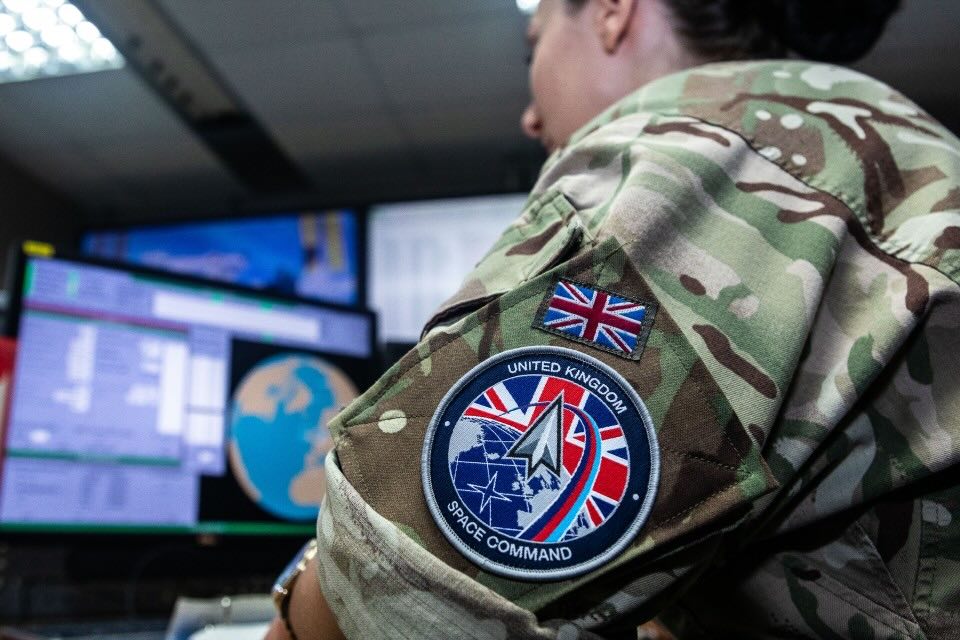
establishment of units like the No. III Space Effects Squadron, British military personnel are shifting from passive tracking to active operational coordination, integrating electronic warfare and counterspace defense into daily command architectures. [U.K. Space Command]
A satellite does not have to be physically destroyed to compromise an operation. Interfering with its communications link, disrupting navigation signals, or temporarily denying access to its sensors can thwart a mission without the debris associated with a destructive blast— that is precisely what makes electronic warfare such a powerful tool in space.
From destruction to disruption
Early counterspace demonstrations focused on physical destruction. Direct-ascent anti-satellite weapons showed the ability to strike objects in orbit, but destructive attacks generate long-lasting debris that threaten other spacecraft in increasingly crowded orbital environments.
Electronic warfare offers a different set of options. Ground-based systems can disrupt the radio-frequency links used to communicate with satellites and transmit data. Depending on the system and circumstances, interference can interrupt communications, degrade signal quality, or deny adversaries access to a space service, all without physically damaging the spacecraft.
Air Chief Marshal Sir Harvey Smyth described No. III Space Effects Squadron as the U.K.’s first unit dedicated to its national Control of Space mission. The Squadron is developing electronic warfare systems and countermeasures against anti-satellite weapons.
The RAF already operates No. I Space Operations Squadron, which will support space domain awareness and U.K. space operations, and No. II Space Warning Squadron, which will provide missile warning and space surveillance through RAF Fylingdales. No. III Space Effects Squadron will defend against hostile activity.
The addition gives the RAF an active-response function alongside its existing watch-and-warn structure.
The U.K.’s move is part of a broader allied shift toward capabilities designed to protect and defend space systems. The United States has also moved toward a more explicit space-control posture. On September 14, Secretary of the Air Force Troy Meink confirmed for the first time at the Air, Space & Cyber Conference in National Harbor, MD, that the Space Force has “on-orbit space control weapons” capable of defending the Joint Force against hostile adversary action.
For the U.K., the focus is to build the operational foundation for its Control of Space mission. For the U.S., Meink’s disclosure confirmed that on-orbit space-control weapons are already deployed. Together, these developments signal a broader shift in how the United States and its allies are readying for conflict in space: fielding capabilities, building organizational structures to operate within them, and bringing once-undisclosed military activities into the public eye.