


Military spacecraft have generally operated from carefully maintained orbital positions, using maneuvers primarily for station-keeping, collision avoidance, or other specific mission requirements.
Apollo Maneuvers 2026 tested a more demanding model: spacecraft maneuvering for operational advantage while examining what it takes to support those operations over time.
Conducted during the first week of September, Apollo Maneuvers was U.S. Space Command’s inaugural live-fly exercise for dynamic on-orbit operations.
The exercise coordinated activities across low Earth orbit (LEO), medium Earth orbit (MEO), and geosynchronous orbit (GEO), while advancing maneuver warfare concepts and examining the logistics required to sustain operations in a contested space environment. The exercise was also designed to generate operational data.
Rather than treating maneuver warfare primarily as a planning concept, Apollo Maneuvers allowed operators to examine the practical requirements associated with executing coordinated movements in orbit and maintaining the systems that support them.
Maneuvering creates new operational requirements
Moving a spacecraft is only one part of a dynamic space operation. Operators must maintain telemetry, tracking, and command links, coordinate activities across ground and space segments, and account for the effects that additional maneuvering can have on spacecraft systems.
Apollo Maneuvers examined constraints associated with non-standard maneuvers, including the terrestrial infrastructure and ground stations required to support telemetry, tracking, and command operations. The exercise also examined opportunities to improve site resilience and ground-station capabilities while reducing sustainment risks to spacecraft subsystems.
Those requirements become more significant as spacecraft operate across different orbital regimes and perform maneuvers beyond routine station-keeping.
The exercise also examined the relationship between maneuvering and spacecraft service life. Additional movement can create demands on spacecraft subsystems and resources, making sustainment a consideration in operational planning.
That is one reason U.S. Space Command has linked Apollo Maneuvers to its broader work on contested logistics and satellite servicing. The command said data collected during the exercise will inform future doctrine, operational plans, and logistics and servicing requirements associated with sustained maneuver and dynamic on-orbit operations.
From maneuvering to sustainment
The technical challenge extends beyond the spacecraft itself. Ground stations and terrestrial networks provide the communications and command infrastructure required to monitor spacecraft, transmit instructions, and receive telemetry. If those systems become unavailable or degraded during a contested operation, the ability of a maneuvering spacecraft to respond can be affected even when the spacecraft itself remains operational.
Apollo Maneuvers therefore considered both material and non-material approaches to improving operational execution and long-term system sustainability. These can include changes to processes, procedures, and planning, as well as improvements to infrastructure and spacecraft support capabilities.
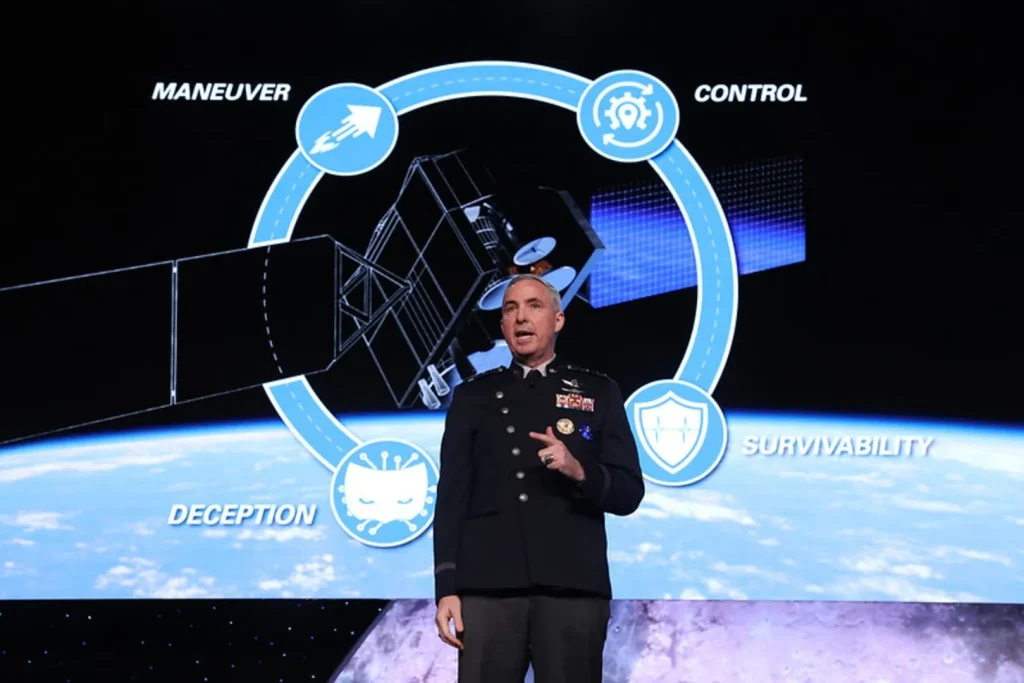
graphic outlining core operational pillars, including maneuver, control, survivability, and deception,
highlighting the military’s shift toward active maneuver warfare in contested orbits. [U.S. Space Command]
The exercise incorporated a Commercial Integration Cell operating from the Combined Space Operations Center at Vandenberg Space Force Base, California, bringing commercial mission partners into the exercise. U.S. Space Command said the integration of allied, partner, and commercial capabilities strengthened joint and combined operations and helped validate combined tactics, techniques, and procedures.
Commercial participation is increasingly relevant as military space operations draw on a broader ecosystem of spacecraft, ground systems, data, and services. Sharing information and integrating commercial capabilities can help operators refine risk assessments, identify mitigation measures, and evaluate how existing systems can support sustained operations.
A coalition approach to dynamic space
The nations participating in Multinational Force-Operation Olympic Defender (Australia, Canada, France, Germany, New Zealand, the United Kingdom, and the United States) worked alongside U.S. forces during the Apollo Maneuvers live-fly exercise.
The multinational participation allowed the command to examine how maneuver operations can be coordinated in a combined environment and placed dynamic space operations within the framework of a multinational force. The exercise’s emphasis on combined tactics and procedures also reflects a broader requirement: space operations increasingly depend on systems and capabilities that extend beyond a single organization or country.
Gen. Stephen Whiting, commander of U.S. Space Command and Multinational Force-Operation Olympic Defender, has described the operational requirement directly: “To perform, survive and gain advantage in the space domain, we need maneuverability and survivability in our capabilities.”
Apollo Maneuvers put that requirement into a live operational setting. Its value will ultimately extend beyond the maneuvers themselves, as the data and lessons gathered during the exercise help shape future doctrine, operational planning, logistics, and satellite-servicing requirements.