

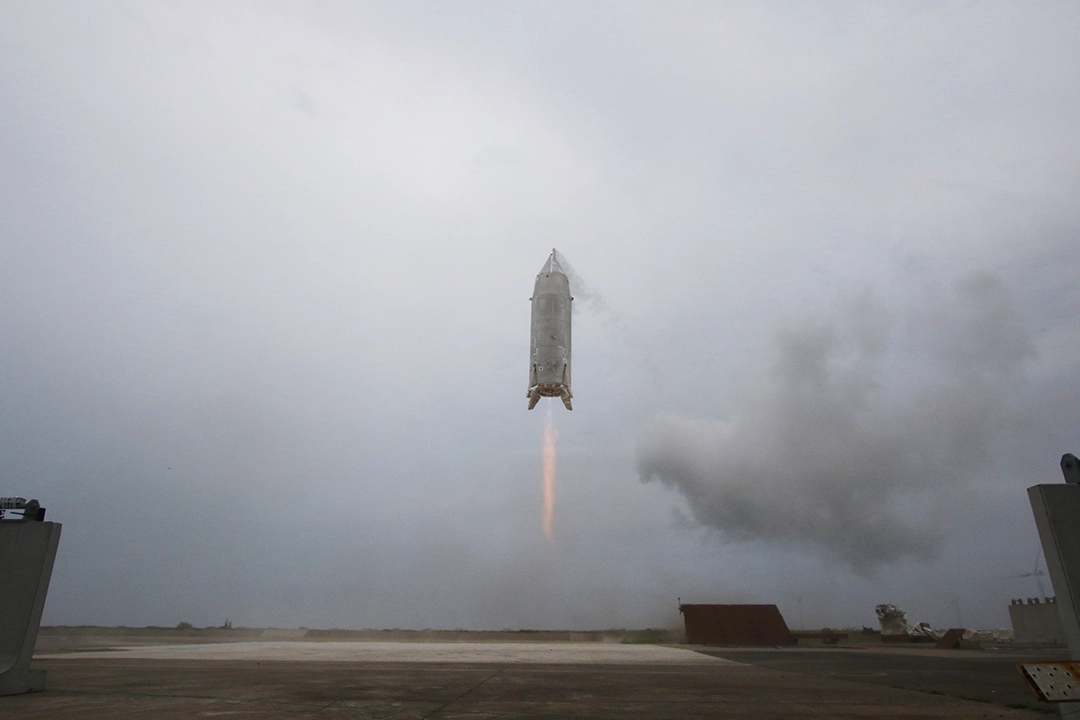
Japan has taken a step toward joining the small group of nations that can reuse rockets after the nation launched and landed its RV-X vehicle in a closely watched test flight.
Officials with the Japan Aerospace Exploration Agency (JAXA) said the experiment could eventually reduce launch costs, strengthen access to space and enhance competitiveness in the global launch market.
In a flight that lasted about 40 seconds, the JAXA prototype rocket lifted off from the Noshiro Testing Center in northeastern Japan, climbed about 11 meters, hovered, moved horizontally approximately 16 meters and landed upright. Although modest in altitude and duration, the July 11 demonstration marked JAXA’s first successful flight test of a reusable launch vehicle prototype and represented years of engineering work aimed at developing a lower-cost successor to Japan’s expendable workhorse the H3 rocket.
“The rocket flew as planned,” Takashi Ito, JAXA’s reusable rocket project manager, said during an online briefing.
For Japan, the demonstration was about more than a short flight. As space becomes central to communications, navigation, intelligence gathering and military operations, the Japanese government considers a reliable domestic space transportation system as essential to national security.
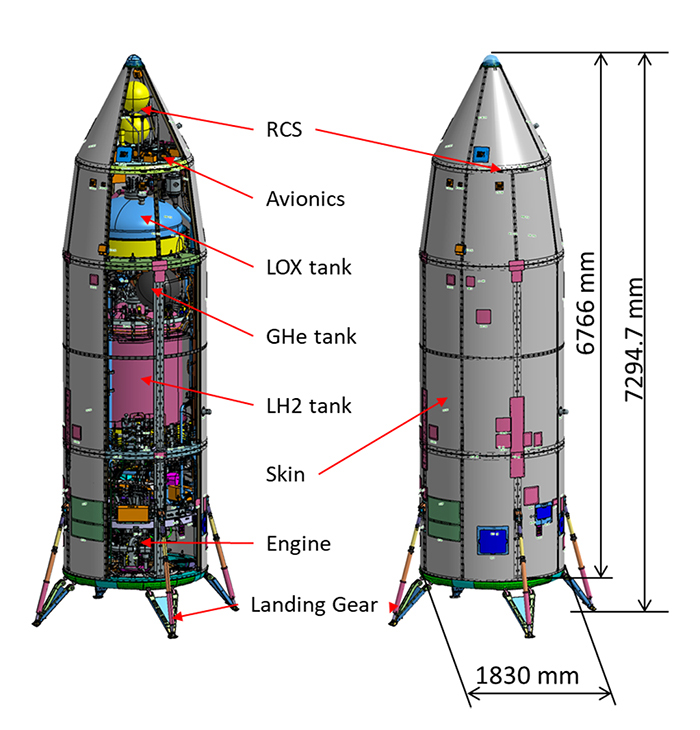
The RV-X prototype is a small test vehicle, measuring 7.3 meters tall and 1.8 meters in diameter. It is powered by a liquid hydrogen engine designed for repeated use and equipped with four shock-absorbing landing legs for controlled vertical landings. Engineers hope technologies validated during the test will be incorporated into Japan’s next generation of orbital launch vehicles.
Ito said the vehicle’s propulsion system has proven remarkably durable during development. “The ‘hardworking’ engine has so far withstood 165 combustion tests,” he said, as reported by the Associated Press.
JAXA’s achievement came during an increasingly competitive period in global launch development. One day before the RV-X test, the Chinese Communist Party announced it had used a net on a sea platform to catch the first stage of a Long March-10B rocket after launch, marking the country’s first successful booster recovery. Like Japan, China hopes reusable rockets will dramatically reduce launch costs while expanding commercial and government access to space.
U.S.-based SpaceX remains the launch industry leader. The company has completed more than 600 first-stage booster recoveries and recently launched the same Falcon 9 first stage for a record 36th flight. Blue Origin also has demonstrated reusable boosters with its New Shepard and New Glenn launch systems. Together, the companies have reshaped the economics of space transportation by recovering and reusing hardware that traditionally had been discarded after each mission.
JAXA has been working on a reusable rocket since 2016 as part of a broader effort to remain competitive in a rapidly evolving global launch market. While the country’s H3 rocket was designed to reduce the cost of launching the highly reliable H-2A, officials believe reusable launch vehicles will be necessary to compete with companies that routinely fly recovered boosters.
Engineers immediately began inspecting the vehicle and analyzing flight data after its recovery to evaluate engine performance, vehicle control and landing dynamics before deciding when to conduct the next test.
“I feel we have put a great deal of time and effort into this, and now that the prototype has taken off and landed without problem, I must say I feel a great sense of relief,” Ito told reporters, according to Channel News Asia. He added that the agency is confident it obtained useful data from the demonstration.
The launch marked a recovery from an earlier setback. According to Aviation Week, JAXA had planned to conduct the first flight in March but postponed the attempt after a malfunction in ground support equipment. Engineers modified the control software, made hardware improvements and strengthened crew training procedures before returning the vehicle to the launch pad.
Japan’s reusable rocket ambitions extend beyond the RV-X program. JAXA is partnering with French and German space agencies to develop CALLISTO, an experimental reusable launch vehicle that will build on technologies demonstrated during the RV-X trial. CALLISTO stands for Cooperative Action Leading to Launcher Innovation in Stage Toss-back Operations. Data collected from the RV-X flight will be incorporated into future CALLISTO testing as the program advances toward higher-altitude demonstrations.
Japan’s commercial sector also has begun investing in reusable launch systems. Last year, Honda R&D became the first Japanese company to successfully test takeoff and landing of a reusable rocket prototype, underscoring growing interest in reusable technology beyond government space programs.
Despite the successful demonstration, experts cautioned that considerable work remains before Japan fields an operational reusable orbital launcher. Future RV-X tests are expected to reach altitudes of about 100 meters while placing greater demands on vehicle guidance, propulsion and landing systems. Engineers will also continue evaluating the durability of the engine and reusable hardware after repeated flights.
Still, the achievement represents an important milestone for a nation seeking to strengthen its role in the commercial and strategic space sectors. For propulsion expert Hideki Moriai of Japan’s Kanazawa Institute of Technology, the successful test should be viewed as the beginning of a much longer journey. “Japan’s reusable rocket technology is still in its infancy,” he told The Japan News. “I hope this test will trigger an acceleration in development.”